Pearson+ LogoPearson+ Logo
Ch.16 Amines
McMurry - Fundamentals of GOB 8th Edition
McMurry8th EditionFundamentals of GOBISBN: 9780134015187Not the one you use?Change textbook
Chapter 16, Problem 53a

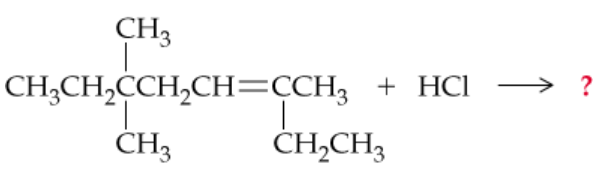
Complete the following equations (Hint: Answers may include concepts learned from previous organic chapters):
a. Chemical equation showing a reaction involving a hydrocarbon and hydrochloric acid, with a question mark indicating an unknown product.

Verified step by step guidance
1
Identify the type of reaction depicted in the image (e.g., substitution, addition, elimination, or oxidation-reduction). This will guide the approach to completing the equation.
Examine the reactants provided in the image. Determine the functional groups present and their reactivity based on organic chemistry principles.
Consider the reaction conditions (e.g., catalysts, temperature, solvent) if provided in the image. These conditions often indicate the type of reaction mechanism involved.
Predict the products by applying the appropriate reaction mechanism. For example, if it is an addition reaction, identify where the new bonds will form, or if it is a substitution reaction, determine which group will be replaced.
Balance the chemical equation by ensuring that the number of atoms of each element is the same on both sides of the equation. Also, verify that the charges are balanced if ions are involved.

Verified video answer for a similar problem:

This video solution was recommended by our tutors as helpful for the problem above.
Was this helpful?

Key Concepts

Here are the essential concepts you must grasp in order to answer the question correctly.

Chemical Equations

Chemical equations represent the transformation of reactants into products during a chemical reaction. They provide a concise way to convey the quantities and types of substances involved, using symbols and formulas. Understanding how to balance these equations is crucial, as it reflects the law of conservation of mass, ensuring that the number of atoms remains constant throughout the reaction.
Recommended video:
Guided course
01:32
Balancing Chemical Equations (Simplified) Concept 1

Functional Groups

Functional groups are specific groups of atoms within molecules that are responsible for the characteristic chemical reactions of those molecules. In organic chemistry, recognizing functional groups is essential for predicting reactivity and understanding the behavior of organic compounds. Examples include hydroxyl (-OH), carboxyl (-COOH), and amino (-NH2) groups, each imparting unique properties to the molecules they are part of.
Recommended video:
Guided course
1:11
Functional Group Priorities Concept 1

Reaction Mechanisms

Reaction mechanisms describe the step-by-step sequence of elementary reactions that occur during a chemical transformation. They provide insight into how reactants convert to products, including the formation and breaking of bonds. Understanding mechanisms is vital for predicting the outcomes of reactions and for designing new synthetic pathways in organic chemistry.
Recommended video:
Guided course
1:30
Alcohol Reactions: Dehydration Reactions Concept 1