Pearson+ LogoPearson+ Logo
Ch.19 Enzymes and Vitamins
McMurry - Fundamentals of GOB 8th Edition
McMurry8th EditionFundamentals of GOBISBN: 9780134015187Not the one you use?Change textbook
Chapter 19, Problem 66

Why do allosteric enzymes have two types of binding sites?

Verified step by step guidance
1
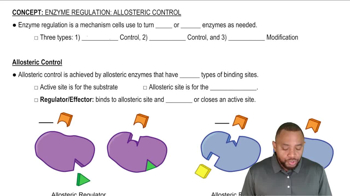
Allosteric enzymes are specialized proteins that regulate biochemical pathways by responding to the needs of the cell. They have two types of binding sites: the active site and the allosteric site.
The active site is where the substrate binds and undergoes a chemical reaction. This is the site responsible for the enzyme's catalytic activity.
The allosteric site is a separate location on the enzyme where regulatory molecules, called allosteric effectors, bind. These effectors can either activate or inhibit the enzyme's activity.
When an allosteric effector binds to the allosteric site, it induces a conformational change in the enzyme's structure. This change can either enhance or reduce the enzyme's ability to bind to the substrate at the active site.
This dual binding site system allows allosteric enzymes to finely tune their activity in response to cellular signals, ensuring that metabolic pathways are efficiently regulated based on the cell's needs.

Verified video answer for a similar problem:

This video solution was recommended by our tutors as helpful for the problem above.
Video duration:
2m
Was this helpful?

Key Concepts

Here are the essential concepts you must grasp in order to answer the question correctly.

Allosteric Regulation

Allosteric regulation refers to the process by which an enzyme's activity is modulated by the binding of an effector molecule at a site other than the active site. This binding can induce conformational changes in the enzyme, enhancing or inhibiting its activity. Allosteric enzymes typically exhibit a sigmoidal kinetic response, reflecting their complex regulation.
Recommended video:
Guided course
2:57
Allosteric Control Concept 1

Active Site vs. Allosteric Site

Allosteric enzymes possess two distinct types of binding sites: the active site, where substrate molecules bind to facilitate the enzymatic reaction, and the allosteric site, where regulatory molecules can bind. The interaction at the allosteric site can lead to changes in the enzyme's shape and function, allowing for fine-tuned control of metabolic pathways.
Recommended video:
Guided course
2:57
Allosteric Control Concept 1

Cooperativity

Cooperativity is a phenomenon observed in allosteric enzymes where the binding of a substrate to one active site affects the binding affinity of additional substrate molecules to other active sites. This can result in increased efficiency of substrate conversion as more substrate molecules bind, illustrating the enzyme's ability to respond dynamically to changes in substrate concentration.
Recommended video:
Guided course
0:59
Steroids Example 2