Pearson+ LogoPearson+ Logo
Ch.25 Protein and Amino Acid Metabolism
McMurry - Fundamentals of GOB 8th Edition
McMurry8th EditionFundamentals of GOBISBN: 9780134015187Not the one you use?Change textbook
Chapter 25, Problem 52

The net reaction for the urea cycle shows that three ATPs are hydrolyzed; however, the total energy “cost” is four ATPs. Explain why this is true.

Verified step by step guidance
1
Understand the urea cycle: The urea cycle is a metabolic pathway that converts toxic ammonia into urea, which can be safely excreted by the body. It involves several enzymatic steps and requires energy input in the form of ATP.
Identify the ATP usage in the urea cycle: During the urea cycle, three ATP molecules are directly hydrolyzed. These are used in the following steps: (1) two ATPs are consumed in the formation of carbamoyl phosphate by the enzyme carbamoyl phosphate synthetase I, and (2) one ATP is used in the conversion of citrulline to argininosuccinate by argininosuccinate synthetase.
Account for the 'energy cost' of ATP hydrolysis: When ATP is hydrolyzed to AMP (as in the formation of carbamoyl phosphate), it is equivalent to the loss of two high-energy phosphate bonds because AMP must be converted back to ATP via two additional phosphorylation steps. This effectively doubles the energy cost for that reaction.
Calculate the total energy cost: In the urea cycle, one ATP is hydrolyzed to AMP (equivalent to two ATPs), and two ATPs are hydrolyzed to ADP. This results in a total energy cost of four ATP equivalents (2 ATPs from AMP hydrolysis + 2 ATPs from ADP hydrolysis).
Summarize the reasoning: Although only three ATP molecules are directly hydrolyzed in the urea cycle, the conversion of ATP to AMP in one step requires additional energy to regenerate ATP, leading to a total energy cost of four ATP equivalents for the cycle.

Verified video answer for a similar problem:

This video solution was recommended by our tutors as helpful for the problem above.
Video duration:
2m
Was this helpful?

Key Concepts

Here are the essential concepts you must grasp in order to answer the question correctly.

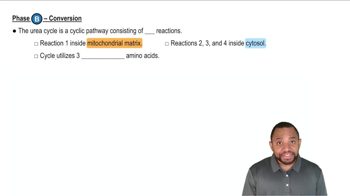
Urea Cycle

The urea cycle is a series of biochemical reactions that convert ammonia, a toxic byproduct of protein metabolism, into urea, which can be excreted from the body. This cycle occurs primarily in the liver and involves several key enzymes and intermediates. Understanding the urea cycle is essential for grasping how nitrogen is processed and eliminated in the body.
Recommended video:
Guided course
0:51
The Urea Cycle Concept 3

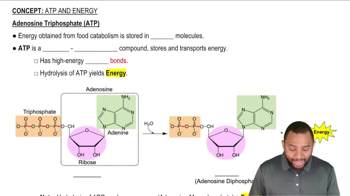
ATP Hydrolysis

ATP hydrolysis refers to the chemical reaction in which adenosine triphosphate (ATP) is broken down into adenosine diphosphate (ADP) and inorganic phosphate, releasing energy. This energy is utilized by cells for various metabolic processes. In the context of the urea cycle, ATP hydrolysis is crucial for driving the reactions that lead to the formation of urea.
Recommended video:
Guided course
2:20
Adenosine Triphosphate (ATP) Concept 2

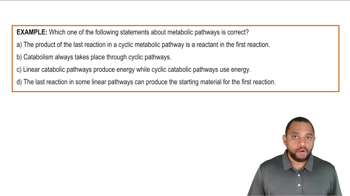
Energy Cost in Metabolic Pathways

The energy cost in metabolic pathways refers to the total amount of energy required to complete a series of biochemical reactions. In the urea cycle, while three ATP molecules are directly hydrolyzed, the equivalent energy cost is considered to be four ATPs due to the energy required for the synthesis of intermediates and the regeneration of ATP. This concept highlights the difference between direct ATP usage and the overall energy expenditure in metabolic processes.
Recommended video:
Guided course
1:32
Metabolic Pathways Example 2