If you were diagnosed as having a diet low in lysine, what foods might you include in your diet to alleviate this problem?
Ch.25 Protein and Amino Acid Metabolism
Chapter 25, Problem 44a
Name the four compounds within the citric acid cycle that the carbon skeletons of the glucogenic amino acid enter as.
Verified step by step guidance1
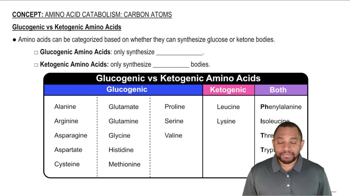
Understand that glucogenic amino acids are those that can be converted into glucose through gluconeogenesis. These amino acids are metabolized into intermediates of the citric acid cycle.
Recall that the citric acid cycle (also known as the Krebs cycle or TCA cycle) is a series of chemical reactions used by all aerobic organisms to release stored energy through the oxidation of acetyl-CoA.
Identify the four key intermediates of the citric acid cycle that glucogenic amino acids can enter as carbon skeletons: oxaloacetate, α-ketoglutarate, succinyl-CoA, and fumarate.
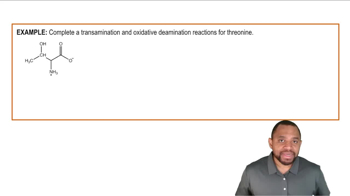
Understand that the carbon skeletons of glucogenic amino acids are converted into these intermediates through transamination or deamination reactions, which remove the amino group and leave behind a keto acid that can enter the cycle.
Recognize that once these intermediates are formed, they can contribute to the production of glucose through gluconeogenesis, as oxaloacetate is a key precursor for glucose synthesis.

Verified video answer for a similar problem:
This video solution was recommended by our tutors as helpful for the problem above.
Video duration:
1mWas this helpful?
Key Concepts
Here are the essential concepts you must grasp in order to answer the question correctly.
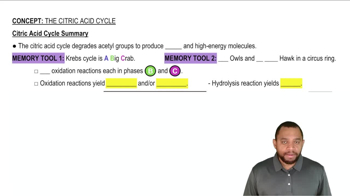
Citric Acid Cycle
The citric acid cycle, also known as the Krebs cycle, is a key metabolic pathway that takes place in the mitochondria. It involves a series of chemical reactions used by all aerobic organisms to generate energy through the oxidation of acetyl-CoA derived from carbohydrates, fats, and proteins. Understanding this cycle is essential for identifying how glucogenic amino acids contribute to energy production.
Recommended video:
Guided course
Citric Acid Cycle Summary Concept 12
Glucogenic Amino Acids
Glucogenic amino acids are those that can be converted into glucose through gluconeogenesis. They enter metabolic pathways that lead to the production of glucose, particularly during periods of fasting or intense exercise. Recognizing which amino acids are glucogenic helps in understanding their role in the citric acid cycle and energy metabolism.
Recommended video:
Guided course
Amino Acid Catabolism: Amino Group Example 2
Carbon Skeletons
The carbon skeleton of an amino acid refers to the carbon chain that remains after the amino group is removed. This structure can be converted into various intermediates that enter the citric acid cycle. Identifying the specific carbon skeletons of glucogenic amino acids is crucial for determining how they integrate into the cycle and contribute to energy production.
Recommended video:
Guided course
Amino Acid Catabolism: Carbon Atoms Concept 1
Related Practice
Textbook Question
623
views
Textbook Question
Diet soft drinks that are sweetened with aspartame carry a warning label for phenylketonurics. Why?
548
views
Textbook Question
Which of the following biomolecules contain nitrogen?
a. Glycogen
b. Nitric oxide
c. Collagen
d. Epinephrine
e. Stearic acid
f. Fructose
583
views
Textbook Question
Can an amino acid be both glucogenic and ketogenic? Explain why or why not.
698
views
Textbook Question
The pancreatic proteases are synthesized and stored as zymogens. They are activated after the pancreatic juices enter the small intestine. Why is it essential that these enzymes be synthesized and stored in their inactive forms?
520
views
Textbook Question
The net reaction for the urea cycle shows that three ATPs are hydrolyzed; however, the total energy “cost” is four ATPs. Explain why this is true.
880
views