Pearson+ LogoPearson+ Logo
Ch.4 Molecular Compounds
McMurry - Fundamentals of GOB 8th Edition
McMurry8th EditionFundamentals of GOBISBN: 9780134015187Not the one you use?Change textbook
Chapter 4, Problem 53c

Expand the following condensed structures into the correct structural formulas.
c. CH3CH2OCH2Cl

Verified step by step guidance
1
Identify the main chain and functional groups in the condensed structure. In CH₃CH₂OCH₂Cl, the main chain consists of two carbon atoms (CH₃ and CH₂) connected by an oxygen atom (O), and there is a chlorine atom (Cl) attached to a CH₂ group.
Start by expanding the CH₃ group. This group represents a carbon atom bonded to three hydrogen atoms: H₃C−.
Next, expand the CH₂ group that is directly bonded to the CH₃ group. This group represents a carbon atom bonded to two hydrogen atoms and connected to the oxygen atom: −CH₂−O−.
Expand the CH₂ group bonded to the oxygen atom. This group represents a carbon atom bonded to two hydrogen atoms and connected to the chlorine atom: −CH₂−Cl.
Combine all the expanded groups to form the complete structural formula: H₃C−CH₂−O−CH₂−Cl. Ensure all bonds and atoms are correctly represented in the structure.

Verified video answer for a similar problem:

This video solution was recommended by our tutors as helpful for the problem above.
Video duration:
4m
Was this helpful?

Key Concepts

Here are the essential concepts you must grasp in order to answer the question correctly.

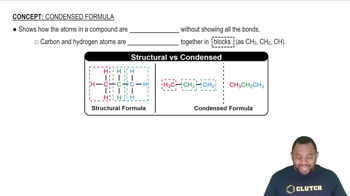
Condensed Structural Formula

A condensed structural formula is a way of representing a chemical compound that shows the arrangement of atoms in a molecule without depicting all the bonds explicitly. It uses symbols and subscripts to indicate the number of atoms and their connectivity, allowing for a more compact representation of the structure. Understanding this format is essential for expanding it into a full structural formula.
Recommended video:
Guided course
1:53
Condensed Formula Concept 1

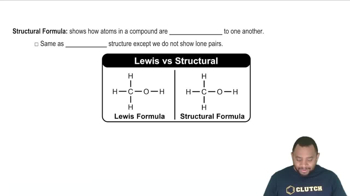
Structural Formula

A structural formula provides a detailed representation of a molecule, illustrating how atoms are bonded together and the spatial arrangement of these atoms. It includes all the bonds (single, double, or triple) between atoms, which is crucial for understanding the molecule's reactivity and properties. Expanding a condensed structure into a structural formula involves identifying these bonds and the arrangement of atoms.
Recommended video:
Guided course
1:01
Structural Formula Concept 2

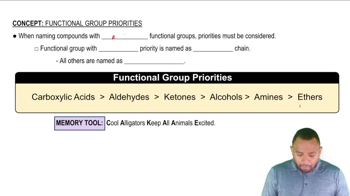
Functional Groups

Functional groups are specific groups of atoms within molecules that are responsible for the characteristic chemical reactions of those molecules. In the given compound, the presence of an ether group (–O–) and a halogen (–Cl) indicates specific reactivity patterns. Recognizing these functional groups is vital for accurately expanding the condensed structure into its full structural formula.
Recommended video:
Guided course
1:11
Functional Group Priorities Concept 1