Pearson+ LogoPearson+ Logo
Ch.4 Introduction to Organic Compounds
Frost - General, Organic and Biological Chemistry 4th Edition
Frost4th EditionGeneral, Organic and Biological ChemistryISBN: 9780134988696Not the one you use?Change textbook
Chapter 1, Problem 6b

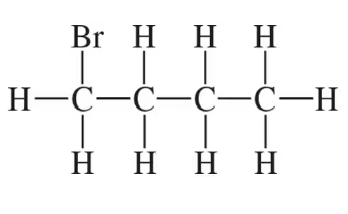
Draw a skeletal structure for each of the following compounds:
(b) Skeletal structure of a carbon chain with bromine and hydrogen atoms represented.

Verified step by step guidance
1
Identify the type of compound represented in the image (e.g., alkane, alkene, alkyne, aromatic compound, etc.) and note any functional groups or substituents present.
Determine the main carbon chain or ring structure, which serves as the backbone of the skeletal structure. Count the number of carbons in the chain or ring.
Simplify the structure by representing carbon atoms as vertices (corners) and omitting hydrogen atoms bonded to carbons. Only show hydrogens attached to heteroatoms (e.g., oxygen, nitrogen) explicitly.
Add any functional groups or substituents to the skeletal structure at the appropriate positions, ensuring correct connectivity and bonding.
Double-check the structure to ensure it adheres to the rules of chemical bonding (e.g., carbon forms four bonds, oxygen forms two bonds, etc.) and matches the original compound in the image.

Verified video answer for a similar problem:

This video solution was recommended by our tutors as helpful for the problem above.
Video duration:
2m
Was this helpful?

Key Concepts

Here are the essential concepts you must grasp in order to answer the question correctly.

Skeletal Structure

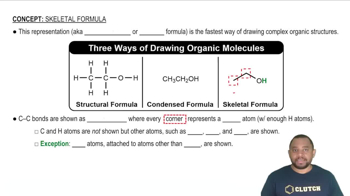
A skeletal structure is a simplified representation of a molecule that shows the arrangement of atoms and bonds without depicting all the hydrogen atoms explicitly. In this format, carbon atoms are represented by vertices or ends of lines, while bonds between them are shown as lines. This method allows chemists to visualize complex organic molecules more easily.
Recommended video:
Guided course
2:26
Skeletal Formula Concept 1

Functional Groups

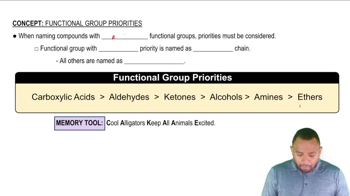
Functional groups are specific groups of atoms within molecules that are responsible for the characteristic chemical reactions of those molecules. They determine the properties and reactivity of organic compounds. Recognizing functional groups is essential for drawing skeletal structures, as they influence how the molecule interacts with other substances.
Recommended video:
Guided course
1:11
Functional Group Priorities Concept 1

Valency and Bonding

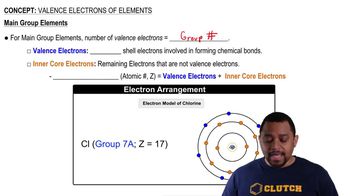
Valency refers to the ability of an atom to bond with other atoms, determined by the number of electrons in its outer shell. In organic chemistry, carbon typically forms four bonds, while other elements like oxygen and nitrogen have different valencies. Understanding valency is crucial for accurately drawing skeletal structures, as it dictates how atoms connect and the overall shape of the molecule.
Recommended video:
Guided course
01:55
Valence Electrons of Elements (Simplified) Concept 1