Back

Classification of Matter definitions

Control buttons has been changed to "navigation" mode.
1/13
  • Matter

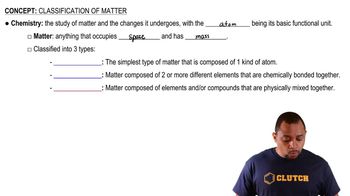
    Anything that occupies space and has mass, forming the basis for all substances studied in chemistry.
  • Atom

    Smallest unit retaining the properties of an element, serving as the fundamental building block of matter.
  • Element

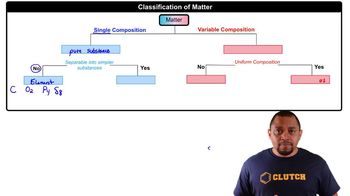
    Pure substance made of only one kind of atom, represented on the periodic table and cannot be broken down further.
  • Compound

    Pure substance consisting of two or more different elements chemically bonded in fixed proportions.
  • Mixture

    Physical combination of elements and/or compounds with variable composition, not chemically bonded.
  • Pure Substance

    Material with a single, uniform composition, either an element or a compound, not mixed with others.
  • Homogeneous Mixture

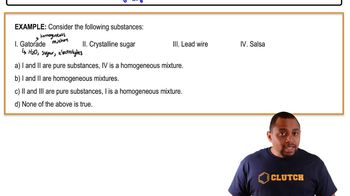
    Mixture with a uniform appearance and composition throughout, making individual components indistinguishable.
  • Heterogeneous Mixture

    Mixture with a non-uniform composition, where different substances remain visibly distinct.
  • Periodic Table

    Organized chart displaying all known elements, each with a unique symbol and atomic structure.
  • Composition

    The specific makeup or combination of substances present in a sample of matter.
  • Chemical Bond

    Attractive force holding atoms together within compounds, resulting in new chemical properties.
  • Symbol

    One- or two-letter abbreviation representing an element, such as C for carbon or O for oxygen.
  • Uniformity

    Degree to which a mixture appears the same throughout, distinguishing homogeneous from heterogeneous mixtures.