Back

Henry's Law Calculations definitions

Control buttons has been changed to "navigation" mode.
1/15
  • Henry's Law Constant

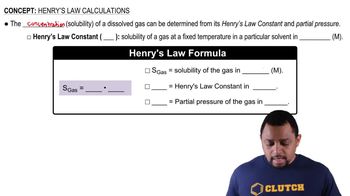
    A proportionality factor indicating how much gas dissolves in a solvent at a set temperature, typically given in molarity per pressure unit.
  • Solubility

    The amount of gas that can dissolve in a solvent, often measured in molarity, and influenced by pressure and temperature.
  • Partial Pressure

    The individual pressure exerted by a specific gas within a mixture, commonly measured in atmospheres.
  • Molarity

    A concentration unit representing moles of solute per liter of solution, frequently used for dissolved gases.
  • Atmosphere

    A standard unit of pressure, often used when expressing gas solubility and Henry's law calculations.
  • Torr

    A pressure unit equivalent to 1/760 of an atmosphere, sometimes used in Henry's law constants.
  • Millimeter of Mercury

    A pressure measurement equal to one torr, occasionally seen in Henry's law constant units.
  • 2.4 Method

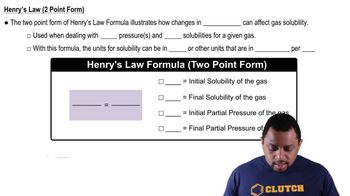
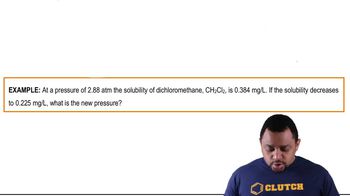
    A comparative approach using ratios of solubility and pressure to analyze changes for a specific gas.
  • Concentration

    A general term for the amount of dissolved substance in a given volume, interchangeable with molarity in this context.
  • Pressure Unit

    A measurement standard such as atmosphere, torr, or millimeter of mercury, crucial for consistent calculations.
  • Initial Solubility

    The starting value for the amount of gas dissolved before any change in pressure occurs.
  • Final Solubility

    The resulting value for the amount of gas dissolved after a pressure change.
  • Initial Pressure

    The starting value for the pressure applied to a gas before any change in solubility.
  • Final Pressure

    The resulting value for the pressure applied to a gas after a change in solubility.
  • Mass per Volume

    An alternative unit for expressing solubility, indicating the amount of substance per unit volume.