Back

Intro to Carbohydrates definitions

Control buttons has been changed to "navigation" mode.
1/14
  • Carbohydrate

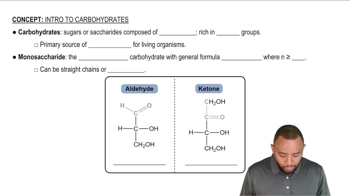
    Molecule made of carbon, hydrogen, and oxygen, rich in hydroxyl groups, and serves as a main energy source for living things.
  • Monosaccharide

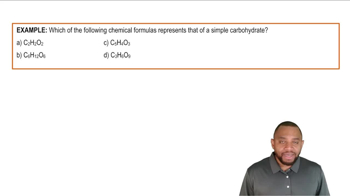
    Simplest form of carbohydrate with the general formula CH2O, existing as straight chains or rings.
  • Hydroxyl Group

    Functional group consisting of an oxygen and hydrogen atom, commonly found attached to carbon atoms in sugars.
  • Aldose

    Sugar containing an aldehyde group, where a carbonyl is bonded to a hydrogen at the end of the molecule.
  • Ketose

    Sugar containing a ketone group, where a carbonyl is bonded to two carbons within the molecule.
  • Carbonyl Group

    Functional group featuring a carbon atom double-bonded to an oxygen, present in both aldehydes and ketones.
  • Generic Name

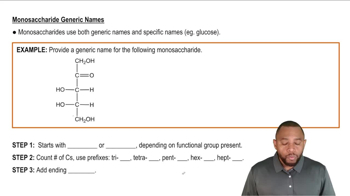
    Naming system for sugars based on functional group, number of carbons, and the suffix 'ose.'
  • Numerical Prefix

    Term used to indicate the number of carbon atoms in a monosaccharide, such as tri-, tetra-, pent-, hex-, or hept-.
  • Pentose

    Monosaccharide containing five carbon atoms, identified by the prefix 'pent.'
  • Ring Structure

    Cyclic form that monosaccharides can adopt, as opposed to a straight-chain arrangement.
  • Straight Chain

    Linear arrangement of atoms in a monosaccharide, as opposed to a cyclic form.
  • Functional Group

    Specific group of atoms within a molecule responsible for characteristic chemical reactions, such as aldehyde or ketone in sugars.
  • Suffix 'ose'

    Ending used in carbohydrate nomenclature to indicate a sugar molecule.
  • Primary Energy Source

    Role of monosaccharides in providing immediate fuel for metabolic processes in living organisms.