Back

Steps of DNA Replication definitions

Control buttons has been changed to "navigation" mode.
1/14
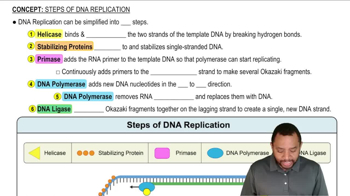
  • Helicase

    An enzyme responsible for unwinding the double helix by breaking hydrogen bonds between nitrogenous bases at the start of replication.
  • Hydrogen Bonds

    Weak attractions between nitrogenous bases that hold the two DNA strands together and are disrupted during strand separation.
  • Stabilizing Proteins

    Molecules that bind to single-stranded DNA, preventing re-annealing and keeping the strands open for replication.
  • Primase

    An enzyme that synthesizes short RNA sequences, providing starting points for DNA synthesis on template strands.
  • RNA Primer

    A short nucleic acid sequence laid down by primase, essential for initiating DNA synthesis by polymerase.
  • DNA Polymerase

    A multifunctional enzyme that adds nucleotides in the 5' to 3' direction and replaces RNA primers with DNA.
  • Okazaki Fragments

    Short DNA segments synthesized discontinuously on the lagging strand, later joined to form a continuous strand.
  • Lagging Strand

    The DNA strand synthesized in short fragments away from the replication fork, requiring multiple primers.
  • Leading Strand

    The DNA strand synthesized continuously in the same direction as the replication fork movement.
  • DNA Ligase

    An enzyme that connects Okazaki fragments by sealing gaps, resulting in a continuous DNA strand.
  • Replication Fork

    The Y-shaped region where the DNA double helix is unwound, allowing new strands to be synthesized.
  • Template Strand

    The original DNA sequence used as a guide for synthesizing a complementary new strand during replication.
  • 5' to 3' Direction

    The orientation in which new DNA nucleotides are added, ensuring proper strand elongation and fidelity.
  • Nitrogenous Bases

    Molecular components of DNA that pair via hydrogen bonds, forming the rungs of the double helix.