Back

Steps of DNA Replication quiz

Control buttons has been changed to "navigation" mode.
1/15
  • What is the first step of DNA replication and which enzyme is involved?

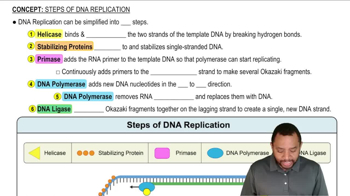
    The first step is unwinding the DNA strands, performed by the helicase enzyme.
  • How does helicase facilitate DNA replication?

    Helicase breaks the hydrogen bonds between nitrogenous bases, opening the DNA double helix.
  • What is the role of stabilizing proteins in DNA replication?

    Stabilizing proteins bind to single-stranded DNA to keep it open for replication.
  • Why must DNA be kept open during replication?

    DNA must be kept open so that enzymes can access the strands and synthesize new DNA.
  • Which enzyme adds RNA primers to the template DNA?

    Primase adds RNA primers to the template DNA.
  • Why are RNA primers necessary in DNA replication?

    RNA primers provide a starting point for DNA polymerase to begin synthesizing new DNA.
  • What are Okazaki fragments and where are they formed?

    Okazaki fragments are short DNA sequences formed on the lagging strand during replication.
  • Why are multiple primers added to the lagging strand?

    Multiple primers are needed because the lagging strand is synthesized discontinuously.
  • In which direction does DNA polymerase add new nucleotides?

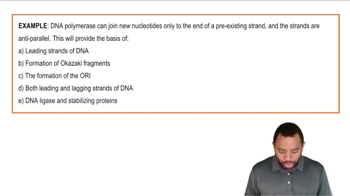
    DNA polymerase adds nucleotides in the 5' to 3' direction.
  • What are the two main functions of DNA polymerase during replication?

    DNA polymerase adds new DNA nucleotides and removes RNA primers, replacing them with DNA.
  • How does DNA polymerase handle RNA primers on the lagging strand?

    DNA polymerase removes the RNA primers and replaces them with DNA nucleotides.
  • What enzyme links Okazaki fragments together?

    DNA ligase links Okazaki fragments together on the lagging strand.
  • What is the result of DNA ligase action on the lagging strand?

    DNA ligase creates a continuous new DNA strand by joining Okazaki fragments.
  • How are the leading and lagging strands different in DNA replication?

    The leading strand is synthesized continuously, while the lagging strand is synthesized in fragments.
  • What is the overall purpose of the six steps in DNA replication?

    The six steps ensure accurate copying of DNA to produce new daughter strands from the template.