Back

Thermochemical Equations definitions

Control buttons has been changed to "navigation" mode.
1/14
  • Thermochemical Equation

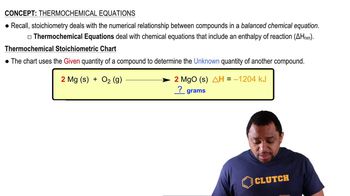
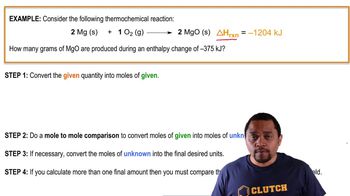
    A balanced chemical reaction paired with an enthalpy change, highlighting energy flow alongside reactant and product amounts.
  • Enthalpy Change

    The heat energy absorbed or released during a chemical reaction, typically represented as delta H.
  • Delta H

    A symbol denoting the enthalpy change for a reaction, indicating whether energy is gained or lost.
  • Stoichiometry

    The quantitative relationship among reactants and products in a balanced chemical equation.
  • Stoichiometric Coefficient

    A number in a chemical equation indicating the relative amount of a substance involved in the reaction.
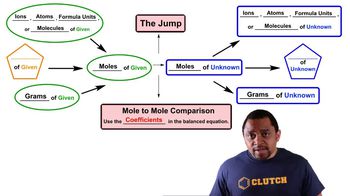
  • Thermochemical Stoichiometric Chart

    A visual tool connecting enthalpy change to moles, grams, or molecules, aiding in energy-related calculations.
  • Mole

    A unit representing 6.022 x 10^23 particles, used to quantify substances in chemical reactions.
  • Gram

    A mass unit used to measure the amount of a substance, often converted from moles in calculations.
  • Molecule

    A group of atoms bonded together, representing the smallest unit of a chemical compound.
  • Formula Unit

    The simplest ratio of ions in an ionic compound, used to express quantities in stoichiometric calculations.
  • Ion

    An atom or group of atoms with a net electric charge, often involved in chemical reactions and calculations.
  • Atom

    The basic unit of a chemical element, serving as a fundamental counting unit in stoichiometry.
  • Balanced Chemical Equation

    A symbolic representation showing equal numbers of each atom type on both sides, ensuring mass conservation.
  • Mole-to-Mole Comparison

    A calculation method using stoichiometric coefficients to relate quantities of different substances in a reaction.