Back

Thermochemical Equations quiz

Control buttons has been changed to "navigation" mode.
1/15
  • What does a thermochemical equation include that a typical chemical equation does not?

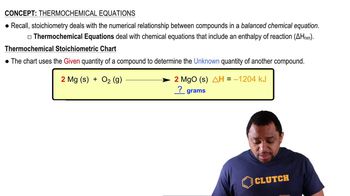
    A thermochemical equation includes the enthalpy change (ΔH of reaction) alongside the balanced chemical equation.
  • What is the main focus of thermochemical equations compared to typical stoichiometry?

    Thermochemical equations focus on the relationship between ΔH and moles, rather than just mole-to-mole comparisons.
  • What is the purpose of the thermochemical stoichiometric chart?

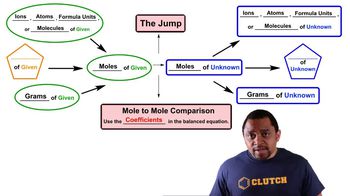
    The chart helps connect the ΔH of a reaction to the moles, grams, or molecules of compounds involved, allowing calculation of unknown quantities.
  • What is the first step when using the thermochemical stoichiometric chart?

    The first step is to start with the given ΔH of the reaction.
  • How do you move from ΔH of given to moles of given in the chart?

    You use the relationship provided by the thermochemical equation to convert ΔH to moles of a specific compound.
  • What is the 'jump' in the thermochemical stoichiometric chart?

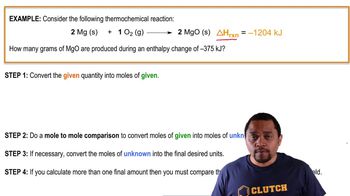
    The 'jump' refers to moving from moles of the given compound to moles of the unknown compound using the balanced equation's coefficients.
  • After finding moles of unknown, what conversions can you perform?

    You can convert moles of unknown to grams, ions, atoms, formula units, molecules, or even a new ΔH.
  • What must be present for a chemical equation to be considered thermochemical?

    The equation must include both a balanced chemical equation and the ΔH of reaction.
  • How does the thermochemical stoichiometric chart build on basic stoichiometry?

    It incorporates energy changes (ΔH) into the stoichiometric relationships between reactants and products.
  • What is the key difference between thermochemical and regular stoichiometry?

    Thermochemical stoichiometry emphasizes ΔH to mole comparisons, while regular stoichiometry focuses on mole-to-mole.
  • What information do you need to perform a mole-to-mole comparison in thermochemical equations?

    You need the coefficients from the balanced chemical equation.
  • Can you start with grams or molecules instead of ΔH in the chart?

    Yes, you can start with grams, ions, atoms, formula units, or molecules and convert to moles of given.
  • Why is understanding basic stoichiometry important for thermochemical equations?

    Because thermochemical equations build on stoichiometry concepts by adding the energy aspect (ΔH).
  • What does ΔH represent in a thermochemical equation?

    ΔH represents the enthalpy change, or heat absorbed or released, during the reaction.
  • What is the ultimate goal when using a thermochemical equation and its chart?

    The goal is to determine unknown quantities (like moles, grams, or ΔH) from known values using the relationships in the equation.