Pearson+ LogoPearson+ Logo
Ch.10 Proteins Workers of the Cell
Frost - General, Organic and Biological Chemistry 4th Edition
Frost4th EditionGeneral, Organic and Biological ChemistryISBN: 9780134988696Not the one you use?Change textbook
Chapter 6, Problem 53a

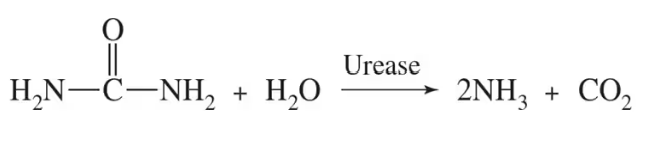
The enzyme urease functions in the body to catalyze the formation of ammonia and carbon dioxide from urea as shown:
Chemical reaction showing urease catalyzing urea and water into ammonia and carbon dioxide.
Describe what effect the following changes would have on the rate of this reaction assuming a steady state has been reached:
a. adding excess urea

Verified step by step guidance
1
Understand the role of urease: Urease is an enzyme that catalyzes the breakdown of urea into ammonia and carbon dioxide. Enzymes speed up reactions by lowering the activation energy required for the reaction to occur.
Recognize the concept of steady state: In a steady state, the reaction rate is constant because the enzyme is working at its maximum capacity, and the concentration of reactants and products remains stable over time.
Consider the effect of adding excess urea: Adding more urea increases the substrate concentration. Initially, this may increase the reaction rate as more substrate molecules are available for the enzyme to act upon.
Understand enzyme saturation: If the enzyme is already saturated (all active sites are occupied), adding excess urea will not further increase the reaction rate. The enzyme can only process a certain amount of substrate at a time.
Conclude the effect: At steady state, adding excess urea will have little to no effect on the reaction rate if the enzyme is already saturated. However, if the enzyme is not saturated, the reaction rate may increase until saturation is reached.

Verified video answer for a similar problem:

This video solution was recommended by our tutors as helpful for the problem above.
Video duration:
5m
Was this helpful?

Key Concepts

Here are the essential concepts you must grasp in order to answer the question correctly.

Enzyme Catalysis

Enzymes are biological catalysts that speed up chemical reactions by lowering the activation energy required for the reaction to occur. In the case of urease, it facilitates the conversion of urea into ammonia and carbon dioxide. Understanding how enzymes function is crucial for predicting how changes in substrate concentration, like adding excess urea, will affect the reaction rate.
Recommended video:
Guided course
2:14
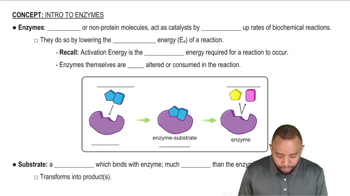
Intro to Enzymes Concept 1

Substrate Concentration

Substrate concentration refers to the amount of substrate available for an enzyme to act upon. According to the Michaelis-Menten kinetics, increasing substrate concentration can increase the reaction rate up to a certain point, known as Vmax, where all enzyme active sites are saturated. In this scenario, adding excess urea would initially increase the reaction rate until the enzyme becomes saturated.
Recommended video:
Guided course
00:52
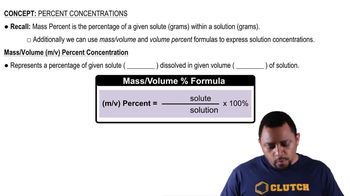
Percent Concentrations Concept 1

Steady State Kinetics

Steady state kinetics describes a condition where the concentration of the enzyme-substrate complex remains constant over time, indicating that the rate of formation of products equals the rate of breakdown of the complex. This concept is important for understanding how changes in substrate concentration, like adding excess urea, will influence the reaction rate without altering the overall enzyme concentration.
Recommended video:
Guided course
01:19
Kinetic Molecular Theory Concept 1