Pearson+ LogoPearson+ Logo
Ch.10 Proteins Workers of the Cell
Frost - General, Organic and Biological Chemistry 4th Edition
Frost4th EditionGeneral, Organic and Biological ChemistryISBN: 9780134988696Not the one you use?Change textbook
Chapter 6, Problem 17c

Draw the structural formula for each of the following peptides:
c. His—Met—Gln

Verified step by step guidance
1
Identify the amino acids in the peptide: Histidine (His), Methionine (Met), and Glutamine (Gln). Each amino acid has a specific structure with an amino group (-NH₂), a carboxyl group (-COOH), and a unique side chain (R group).
Determine the order of the peptide chain: The sequence is His—Met—Gln, meaning Histidine is the N-terminal (starting amino acid), Methionine is in the middle, and Glutamine is the C-terminal (ending amino acid).
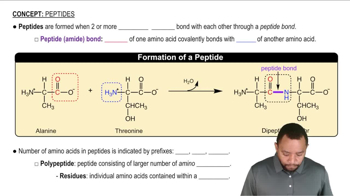
Connect the amino acids via peptide bonds: A peptide bond forms between the carboxyl group (-COOH) of one amino acid and the amino group (-NH₂) of the next amino acid. Remove a molecule of water (H₂O) during each bond formation.
Draw the backbone of the peptide: The backbone consists of repeating units of -NH-CH(R)-CO-, where R represents the side chain of each amino acid. For this peptide, include the side chains of Histidine (imidazole group), Methionine (thioether group), and Glutamine (amide group).
Add terminal groups: Ensure the N-terminal (Histidine) retains its free amino group (-NH₂) and the C-terminal (Glutamine) retains its free carboxyl group (-COOH). Double-check the structure for accuracy and completeness.

Verified video answer for a similar problem:

This video solution was recommended by our tutors as helpful for the problem above.
Video duration:
1m
Was this helpful?

Key Concepts

Here are the essential concepts you must grasp in order to answer the question correctly.

Peptide Structure

Peptides are short chains of amino acids linked by peptide bonds. Each amino acid has a specific structure consisting of an amino group, a carboxyl group, and a side chain (R group) that determines its properties. The sequence of amino acids in a peptide dictates its structure and function, making it essential to understand how to represent these connections in a structural formula.
Recommended video:
Guided course
3:07
Peptides Concept 1

Amino Acids

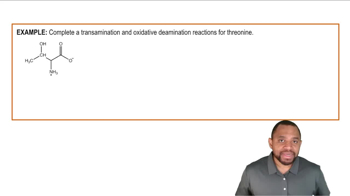
Amino acids are the building blocks of peptides and proteins, with 20 standard amino acids commonly found in nature. Each amino acid has a unique side chain that influences its chemical behavior and interactions. In the peptide His—Met—Gln, histidine (His), methionine (Met), and glutamine (Gln) are the specific amino acids that need to be represented in the structural formula.
Recommended video:
Guided course
3:03
Amino Acid Catabolism: Amino Group Example 2

Structural Formula Representation

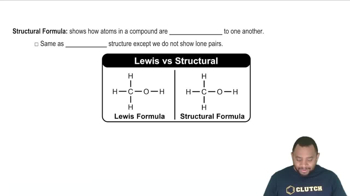
The structural formula of a peptide visually represents the arrangement of atoms and the bonds between them. It typically shows the backbone of the peptide, which consists of repeating units of the amino group and carboxyl group, along with the side chains of the constituent amino acids. Understanding how to draw this representation is crucial for accurately depicting the peptide's structure.
Recommended video:
Guided course
1:01
Structural Formula Concept 2