Pearson+ LogoPearson+ Logo
Ch.10 Proteins Workers of the Cell
Frost - General, Organic and Biological Chemistry 4th Edition
Frost4th EditionGeneral, Organic and Biological ChemistryISBN: 9780134988696Not the one you use?Change textbook
Chapter 6, Problem 16b

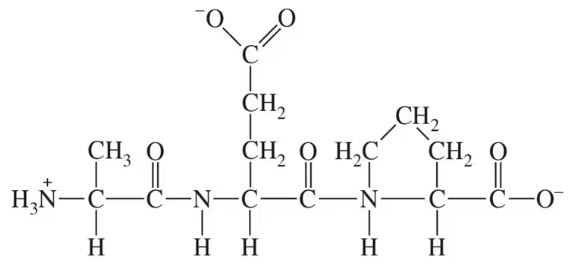
Consider the following tripeptide:

b. Give the one-letter and three-letter abbreviations of this tripeptide.

Verified step by step guidance
1
Identify the amino acids present in the tripeptide by analyzing the structure provided in the image. Look for the side chains and backbone structure to determine the specific amino acids.
Determine the three-letter abbreviations for each amino acid based on their chemical structure. Common examples include Gly for glycine, Ala for alanine, and Phe for phenylalanine.
Combine the three-letter abbreviations in the order they appear in the tripeptide sequence to represent the full tripeptide using three-letter codes.
Determine the one-letter abbreviations for each amino acid using the standard amino acid one-letter code chart. For example, Gly is G, Ala is A, and Phe is F.
Combine the one-letter abbreviations in the order they appear in the tripeptide sequence to represent the full tripeptide using one-letter codes.

Verified video answer for a similar problem:

This video solution was recommended by our tutors as helpful for the problem above.
Video duration:
4m
Was this helpful?

Key Concepts

Here are the essential concepts you must grasp in order to answer the question correctly.

Amino Acids

Amino acids are the building blocks of proteins, consisting of a central carbon atom, an amino group, a carboxyl group, a hydrogen atom, and a variable R group. Each amino acid has a unique side chain that determines its properties and role in protein structure. In a tripeptide, three amino acids are linked together by peptide bonds, forming a specific sequence that influences the peptide's function.
Recommended video:
Guided course
3:03
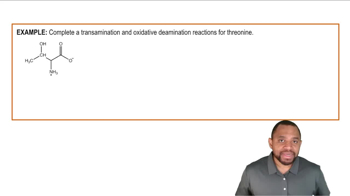
Amino Acid Catabolism: Amino Group Example 2

Peptide Bonds

Peptide bonds are covalent bonds that link amino acids together in a protein or peptide chain. They form through a dehydration synthesis reaction, where the carboxyl group of one amino acid reacts with the amino group of another, releasing a molecule of water. Understanding peptide bonds is crucial for analyzing the structure and function of peptides, including tripeptides.
Recommended video:
Guided course
1:24
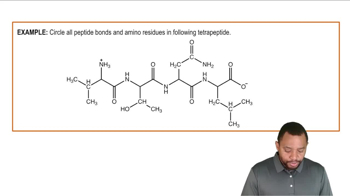
Peptides Example 1

Abbreviations of Amino Acids

Amino acids are commonly represented by one-letter and three-letter abbreviations, which are standardized for ease of communication in biochemistry. For example, alanine is abbreviated as 'A' (one-letter) and 'Ala' (three-letter). Knowing these abbreviations is essential for identifying and discussing peptides and proteins succinctly, especially in scientific literature.
Recommended video:
Guided course
3:03
Amino Acid Catabolism: Amino Group Example 2