Pearson+ LogoPearson+ Logo
Ch.10 Proteins Workers of the Cell
Frost - General, Organic and Biological Chemistry 4th Edition
Frost4th EditionGeneral, Organic and Biological ChemistryISBN: 9780134988696Not the one you use?Change textbook
Chapter 6, Problem 56a

Give the name and three-letter abbreviation for the amino acid described by each of the following:
a. the nonpolar amino acid with a sulfur atom in its side chain

Verified step by step guidance
1
Step 1: Recall that amino acids are classified based on the properties of their side chains, such as being nonpolar, polar, acidic, or basic. Nonpolar amino acids typically have hydrophobic side chains.
Step 2: Identify the amino acid with a sulfur atom in its side chain. Sulfur-containing amino acids include methionine and cysteine. Among these, methionine is nonpolar, while cysteine is polar due to its ability to form disulfide bonds.
Step 3: Confirm that methionine is the correct amino acid for this description because it has a nonpolar side chain containing a sulfur atom.
Step 4: Determine the three-letter abbreviation for methionine. The standard abbreviation for methionine is 'Met'.
Step 5: Conclude that the name of the amino acid is methionine, and its three-letter abbreviation is 'Met'.

Verified video answer for a similar problem:

This video solution was recommended by our tutors as helpful for the problem above.
Video duration:
3m
Was this helpful?

Key Concepts

Here are the essential concepts you must grasp in order to answer the question correctly.

Amino Acids

Amino acids are organic compounds that serve as the building blocks of proteins. Each amino acid consists of a central carbon atom, an amino group, a carboxyl group, a hydrogen atom, and a variable side chain (R group) that determines its properties. There are 20 standard amino acids, categorized into polar, nonpolar, acidic, and basic groups based on their side chains.
Recommended video:
Guided course
3:03
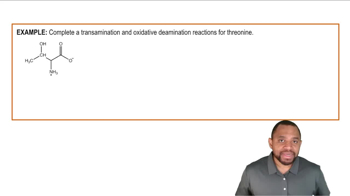
Amino Acid Catabolism: Amino Group Example 2

Nonpolar Amino Acids

Nonpolar amino acids have side chains that are hydrophobic, meaning they do not interact well with water. These amino acids tend to cluster together in the interior of proteins, stabilizing their structure through hydrophobic interactions. Examples include alanine, valine, and leucine, but the specific amino acid in the question is cysteine, which contains a sulfur atom in its side chain.
Recommended video:
Guided course
5:16
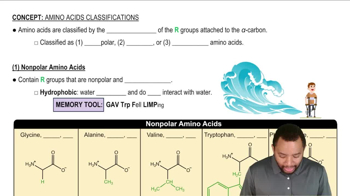
Nonpolar Amino Acids Concept 1

Cysteine

Cysteine is a nonpolar amino acid characterized by the presence of a thiol (-SH) group in its side chain, which contains sulfur. This unique feature allows cysteine to form disulfide bonds with other cysteine residues, contributing to the stabilization of protein structures. The three-letter abbreviation for cysteine is 'Cys'.
Recommended video:
Guided course
2:41
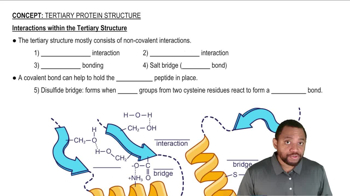
Interactions within the Tertiary Structure Concept 2