
Pearson+ LogoPearson+ Logo
Ch.10 Proteins Workers of the Cell
Frost - General, Organic and Biological Chemistry 4th Edition
Frost4th EditionGeneral, Organic and Biological ChemistryISBN: 9780134988696Not the one you use?Change textbook
Chapter 6, Problem 99

How does an irreversible inhibitor function differently than a reversible inhibitor?

Verified step by step guidance
1
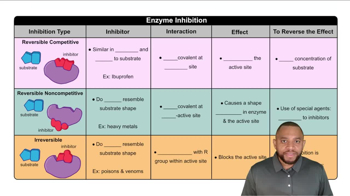
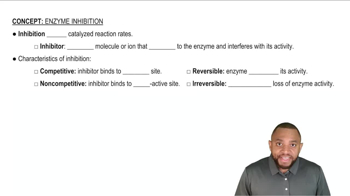
Irreversible inhibitors bind permanently to an enzyme, often through covalent bonds, leading to a permanent loss of enzyme activity.
Reversible inhibitors bind temporarily to an enzyme, usually through non-covalent interactions, and can be removed, allowing the enzyme to regain activity.
Irreversible inhibition often involves the inhibitor reacting with an amino acid residue at the active site of the enzyme, forming a stable complex.
Reversible inhibitors can be competitive, non-competitive, or uncompetitive, each affecting enzyme activity in different ways depending on their binding site and mechanism.
In the case of irreversible inhibitors, the enzyme's function is permanently altered, whereas reversible inhibitors allow for regulation of enzyme activity based on the concentration of the inhibitor.

Verified video answer for a similar problem:

This video solution was recommended by our tutors as helpful for the problem above.
Video duration:
6m
Was this helpful?

Key Concepts

Here are the essential concepts you must grasp in order to answer the question correctly.

Irreversible Inhibitors

Irreversible inhibitors bind permanently to an enzyme, often through covalent bonds, leading to a permanent loss of enzymatic activity. This type of inhibition typically results in a decrease in the total number of active enzyme molecules available for catalysis, as the inhibitor modifies the enzyme's structure, rendering it inactive.
Recommended video:
Guided course
3:26
Enzyme Inhibition Concept 2

Reversible Inhibitors

Reversible inhibitors bind to enzymes through non-covalent interactions, such as hydrogen bonds or ionic interactions, allowing them to dissociate from the enzyme. This means that the inhibition can be reversed, and the enzyme can regain its activity once the inhibitor is removed, making this type of inhibition more dynamic and dependent on the concentration of the inhibitor.
Recommended video:
Guided course
3:26
Enzyme Inhibition Concept 2

Mechanisms of Inhibition

The mechanisms of inhibition refer to how inhibitors affect enzyme activity. Irreversible inhibitors typically cause permanent changes to the enzyme's active site, while reversible inhibitors can compete with substrates or bind to allosteric sites, altering the enzyme's function without permanently modifying its structure. Understanding these mechanisms is crucial for drug design and enzyme regulation.
Recommended video:
Guided course
1:19
Enzyme Inhibition Concept 1