Pearson+ LogoPearson+ Logo
Ch.10 Proteins Workers of the Cell
Frost - General, Organic and Biological Chemistry 4th Edition
Frost4th EditionGeneral, Organic and Biological ChemistryISBN: 9780134988696Not the one you use?Change textbook
Chapter 6, Problem 95a

Pepsin, an enzyme that hydrolyzes peptide bonds in proteins, functions in the stomach at a pH optimum of 1.5 to 2.0. How is the rate of a pepsin-catalyzed reaction affected by each of the following conditions?
a. increasing the concentration of proteins

Verified step by step guidance
1
Understand the role of pepsin: Pepsin is an enzyme that catalyzes the hydrolysis of peptide bonds in proteins. Enzymes speed up reactions by lowering the activation energy required for the reaction to occur.
Recognize the relationship between substrate concentration and enzyme activity: Enzyme activity generally increases with an increase in substrate concentration (in this case, proteins) up to a certain point, as more substrate molecules are available for the enzyme to act upon.
Consider the concept of enzyme saturation: At low substrate concentrations, increasing the concentration of proteins will increase the rate of the reaction because more substrate molecules can bind to the active sites of the enzyme. However, at high substrate concentrations, the enzyme may become saturated, meaning all active sites are occupied, and the reaction rate will no longer increase significantly.
Relate this to the specific case of pepsin: If the concentration of proteins is increased within the range where pepsin is not yet saturated, the rate of the pepsin-catalyzed reaction will increase. If the enzyme is already saturated, further increasing the protein concentration will not significantly affect the reaction rate.
Conclude with the importance of optimal conditions: Ensure that the pH remains within the optimal range (1.5 to 2.0) for pepsin activity, as deviations from this range can denature the enzyme or reduce its efficiency, regardless of substrate concentration.

Verified video answer for a similar problem:

This video solution was recommended by our tutors as helpful for the problem above.
Video duration:
5m
Was this helpful?

Key Concepts

Here are the essential concepts you must grasp in order to answer the question correctly.

Enzyme Catalysis

Enzyme catalysis refers to the process by which enzymes accelerate chemical reactions. Enzymes, like pepsin, lower the activation energy required for reactions, allowing them to occur more quickly. The rate of an enzyme-catalyzed reaction is influenced by factors such as substrate concentration, temperature, and pH.
Recommended video:
Guided course
2:14
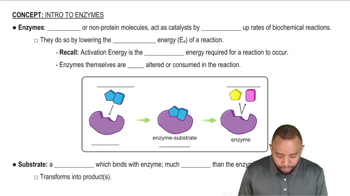
Intro to Enzymes Concept 1

Substrate Concentration

Substrate concentration is the amount of substrate available for an enzyme to act upon. In the case of pepsin, increasing the concentration of proteins (the substrate) generally leads to an increase in the reaction rate, up to a certain point. This is due to more substrate molecules being available to bind to the enzyme, enhancing the likelihood of enzyme-substrate complexes forming.
Recommended video:
Guided course
00:52
Percent Concentrations Concept 1

Michaelis-Menten Kinetics

Michaelis-Menten kinetics describes the rate of enzyme-catalyzed reactions as a function of substrate concentration. It illustrates how reaction rates increase with substrate concentration until a maximum velocity (Vmax) is reached, beyond which additional substrate does not increase the rate. This model is crucial for understanding how enzymes like pepsin behave under varying substrate conditions.
Recommended video:
Guided course
01:19
Kinetic Molecular Theory Concept 1