Pearson+ LogoPearson+ Logo
Ch.10 Proteins Workers of the Cell
Frost - General, Organic and Biological Chemistry 4th Edition
Frost4th EditionGeneral, Organic and Biological ChemistryISBN: 9780134988696Not the one you use?Change textbook
Chapter 6, Problem 75a

Indicate what type(s) of intermolecular forces are disrupted and what level of protein structure is changed by the following denaturing treatments:
a. an egg placed in water at 100 °C and boiled for 10 minutes

Verified step by step guidance
1
Understand that proteins have four levels of structure: primary (sequence of amino acids), secondary (alpha-helices and beta-sheets formed by hydrogen bonding), tertiary (3D folding stabilized by various intermolecular forces), and quaternary (arrangement of multiple polypeptide chains). Denaturation disrupts higher levels of structure without breaking peptide bonds (primary structure remains intact).
Recognize that boiling an egg involves exposing proteins to high temperatures. Heat disrupts intermolecular forces that stabilize the secondary, tertiary, and quaternary structures of proteins.
Identify the types of intermolecular forces disrupted by heat: hydrogen bonds (important in secondary structure), hydrophobic interactions, and van der Waals forces (important in tertiary and quaternary structures). Heat causes these forces to break, leading to protein unfolding.
Note that the primary structure of the protein remains unchanged because the covalent peptide bonds between amino acids are not broken by heat.
Conclude that the denaturation caused by boiling an egg disrupts hydrogen bonds, hydrophobic interactions, and van der Waals forces, leading to the loss of secondary, tertiary, and quaternary structures, while the primary structure remains intact.

Verified video answer for a similar problem:

This video solution was recommended by our tutors as helpful for the problem above.
Video duration:
5m
Was this helpful?

Key Concepts

Here are the essential concepts you must grasp in order to answer the question correctly.

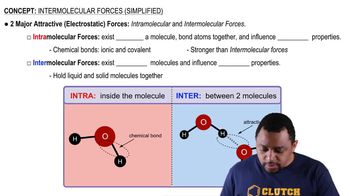
Intermolecular Forces

Intermolecular forces are the attractive forces between molecules that influence physical properties such as boiling and melting points. In proteins, these forces include hydrogen bonds, ionic interactions, and van der Waals forces, which help maintain the protein's three-dimensional structure. Disruption of these forces can lead to denaturation, altering the protein's functionality.
Recommended video:
Guided course
01:59
Intermolecular Forces (Simplified) Concept 1

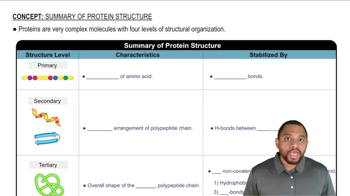
Protein Structure Levels

Proteins have four levels of structure: primary (amino acid sequence), secondary (alpha helices and beta sheets), tertiary (three-dimensional folding), and quaternary (multiple polypeptide chains). Denaturation typically affects secondary and tertiary structures, as the disruption of intermolecular forces leads to unfolding and loss of the protein's functional shape.
Recommended video:
Guided course
2:56
Summary of Protein Structure Concept 1

Denaturation

Denaturation is the process by which proteins lose their native structure due to external stressors such as heat, pH changes, or chemical agents. In the case of boiling an egg, the high temperature disrupts hydrogen bonds and other interactions, causing the proteins in the egg to unfold and aggregate, resulting in the solidification of the egg white and yolk.
Recommended video:
Guided course
1:17
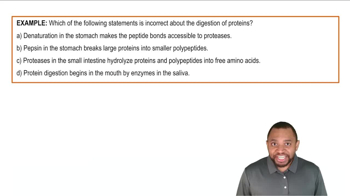
Digestion of Proteins Example 1