Pearson+ LogoPearson+ Logo
Ch.10 Proteins Workers of the Cell
Frost - General, Organic and Biological Chemistry 4th Edition
Frost4th EditionGeneral, Organic and Biological ChemistryISBN: 9780134988696Not the one you use?Change textbook
Chapter 6, Problem 76

Describe the changes that occur in the primary structure when a protein is denatured versus when a protein is hydrolyzed.

Verified step by step guidance
1
Understand the primary structure of a protein: The primary structure refers to the sequence of amino acids in a polypeptide chain, linked by peptide bonds. This sequence determines the protein's overall structure and function.
Define denaturation: Denaturation is a process where a protein loses its higher-order structures (secondary, tertiary, and quaternary) due to external factors like heat, pH changes, or chemicals. However, the primary structure (the sequence of amino acids) remains intact because peptide bonds are not broken.
Define hydrolysis: Hydrolysis is a chemical reaction where water is used to break the peptide bonds between amino acids in the protein's primary structure. This process results in the breakdown of the protein into smaller peptides or individual amino acids.
Compare the effects of denaturation and hydrolysis: Denaturation alters the protein's shape and function by disrupting non-covalent interactions and disulfide bonds, but it does not change the amino acid sequence. In contrast, hydrolysis directly breaks the peptide bonds, altering the primary structure and resulting in smaller fragments or free amino acids.
Summarize the key difference: Denaturation affects the protein's higher-order structures without altering the primary structure, while hydrolysis directly breaks the primary structure by cleaving peptide bonds.

Verified video answer for a similar problem:

This video solution was recommended by our tutors as helpful for the problem above.
Video duration:
3m
Was this helpful?

Key Concepts

Here are the essential concepts you must grasp in order to answer the question correctly.

Protein Denaturation

Protein denaturation refers to the process where a protein loses its native structure due to external stressors such as heat, pH changes, or chemical agents. This alteration affects the protein's secondary, tertiary, and quaternary structures, but the primary structure, which is the sequence of amino acids, remains intact. Denaturation can lead to loss of function, as the specific shape of the protein is crucial for its biological activity.
Recommended video:
Guided course
1:17
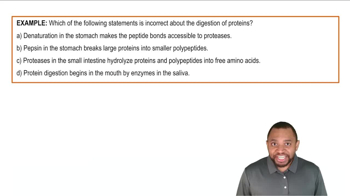
Digestion of Proteins Example 1

Protein Hydrolysis

Protein hydrolysis is a chemical reaction that involves the breaking of peptide bonds between amino acids in a protein, resulting in smaller peptides or free amino acids. This process is typically catalyzed by enzymes or occurs under acidic or basic conditions. Unlike denaturation, hydrolysis fundamentally alters the primary structure of the protein, as it reduces the number of amino acids linked together, leading to a complete loss of the original protein's structure and function.
Recommended video:
Guided course
1:12
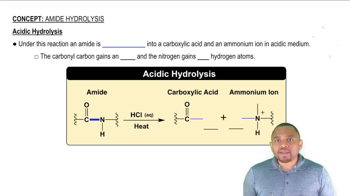
Acidic Hydrolysis Concept 1

Primary Structure of Proteins

The primary structure of a protein is defined as the linear sequence of amino acids that are linked by peptide bonds. This sequence determines the protein's unique characteristics and ultimately influences its higher-order structures and functions. Changes to the primary structure, such as those caused by hydrolysis, can have significant implications for the protein's stability and biological activity, while denaturation affects the protein's shape without altering the amino acid sequence.
Recommended video:
Guided course
1:11
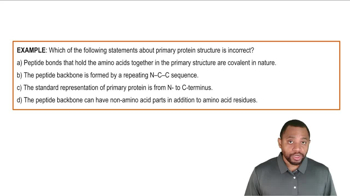
Primary Protein Structure Example 1