Pearson+ LogoPearson+ Logo
Ch.11 Nucleic Acids Big Molecules with a Big Role
Frost - General, Organic and Biological Chemistry 4th Edition
Frost4th EditionGeneral, Organic and Biological ChemistryISBN: 9780134988696Not the one you use?Change textbook
Chapter 7, Problem 73

What is the one-letter amino acid sequence formed from the following mRNA that codes for a pentapeptide that is an endorphin called Met-enkephalin?
5'AUG|UAC|GGU|GGA|UUU|AUG|UAA3'

Verified step by step guidance
1
Identify the start codon in the mRNA sequence. The start codon is typically 'AUG', which codes for the amino acid methionine (Met). This indicates where translation begins.
Divide the mRNA sequence into codons (groups of three nucleotides). For the given sequence, the codons are: AUG, UAC, GGU, GGA, UUU, AUG, UAA.
Use the genetic code table to translate each codon into its corresponding amino acid. For example: AUG = Met, UAC = Tyr, GGU = Gly, GGA = Gly, UUU = Phe, AUG = Met.
Stop translation when you encounter a stop codon. In this sequence, 'UAA' is a stop codon, which signals the end of the peptide chain.
Combine the one-letter abbreviations of the amino acids in the order they appear to form the amino acid sequence. For example, Met = M, Tyr = Y, Gly = G, Phe = F, etc.

Verified video answer for a similar problem:

This video solution was recommended by our tutors as helpful for the problem above.
Video duration:
1m
Was this helpful?

Key Concepts

Here are the essential concepts you must grasp in order to answer the question correctly.

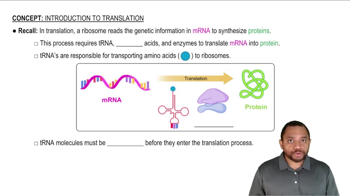
mRNA Translation

mRNA translation is the process by which ribosomes synthesize proteins based on the sequence of nucleotides in messenger RNA (mRNA). Each set of three nucleotides, known as a codon, corresponds to a specific amino acid. Understanding this process is crucial for determining the amino acid sequence encoded by the mRNA.
Recommended video:
Guided course
1:42
Introduction to Translation Concept 1

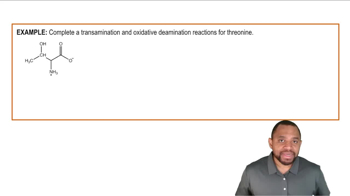
Amino Acids and Codons

Amino acids are the building blocks of proteins, and each amino acid is represented by one or more codons in the genetic code. The genetic code is universal and consists of 64 codons that specify 20 different amino acids. Knowing the codons that correspond to specific amino acids is essential for translating mRNA sequences into protein sequences.
Recommended video:
Guided course
3:03
Amino Acid Catabolism: Amino Group Example 2

Endorphins and Met-enkephalin

Endorphins are neuropeptides that function as neurotransmitters and are involved in pain relief and pleasure. Met-enkephalin is a specific type of endorphin composed of five amino acids. Understanding the structure and function of Met-enkephalin helps in recognizing its role in the body's response to stress and pain.
Recommended video:
Guided course
01:22
Percent Concentrations Example 2