Pearson+ LogoPearson+ Logo
Ch.11 Nucleic Acids Big Molecules with a Big Role
Frost - General, Organic and Biological Chemistry 4th Edition
Frost4th EditionGeneral, Organic and Biological ChemistryISBN: 9780134988696Not the one you use?Change textbook
Chapter 7, Problem 39c

Consider the following portion of mRNA produced by the normal order of DNA nucleotides:
5'CUU|AAA|CGA|GUU3'
c. Write the amino acid sequence if a mutation changes CGA to AGA. Is this likely to affect protein function?

Verified step by step guidance
1
Step 1: Understand the problem. The mRNA sequence provided is 5'CUU|AAA|CGA|GUU3'. A mutation changes CGA to AGA. The task is to determine the amino acid sequence after the mutation and assess whether this change is likely to affect protein function.
Step 2: Recall the genetic code. Each codon (group of three nucleotides) in mRNA corresponds to a specific amino acid. Use a codon chart to identify the amino acids for the original sequence and the mutated sequence.
Step 3: Translate the original mRNA sequence. Using the codon chart, determine the amino acids for each codon: CUU, AAA, CGA, and GUU.
Step 4: Translate the mutated mRNA sequence. Replace CGA with AGA and use the codon chart to determine the amino acid sequence for CUU, AAA, AGA, and GUU.
Step 5: Compare the amino acid sequences. Determine if the mutation changes the amino acid at the position corresponding to CGA. If the amino acid remains the same (a synonymous mutation), it is less likely to affect protein function. If the amino acid changes (a nonsynonymous mutation), assess whether the new amino acid could impact the protein's structure or function based on its properties.

Verified video answer for a similar problem:

This video solution was recommended by our tutors as helpful for the problem above.
Video duration:
1m
Was this helpful?

Key Concepts

Here are the essential concepts you must grasp in order to answer the question correctly.

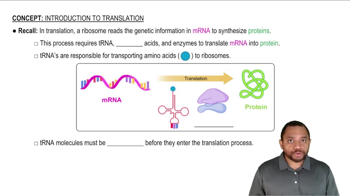
mRNA Translation

mRNA translation is the process by which ribosomes synthesize proteins based on the sequence of nucleotides in mRNA. Each set of three nucleotides, called a codon, corresponds to a specific amino acid. Understanding this process is crucial for determining how changes in the mRNA sequence can affect the resulting protein.
Recommended video:
Guided course
1:42
Introduction to Translation Concept 1

Amino Acid Codons

Amino acid codons are sequences of three nucleotides in mRNA that specify which amino acid will be added during protein synthesis. The genetic code is nearly universal, with specific codons corresponding to specific amino acids. A mutation in a codon can lead to a different amino acid being incorporated, potentially altering the protein's structure and function.
Recommended video:
Guided course
3:03
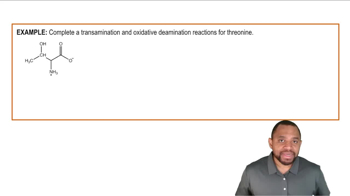
Amino Acid Catabolism: Amino Group Example 2

Mutation Impact on Protein Function

Mutations can have varying effects on protein function, ranging from benign to detrimental. A change in a single codon may result in a different amino acid, which can affect the protein's folding, stability, or activity. Evaluating whether a mutation affects protein function requires understanding the role of the specific amino acid in the protein's overall structure and function.
Recommended video:
Guided course
02:16
Logarithmic Functions