Pearson+ LogoPearson+ Logo
Ch.4 Introduction to Organic Compounds
Frost - General, Organic and Biological Chemistry 4th Edition
Frost4th EditionGeneral, Organic and Biological ChemistryISBN: 9780134988696Not the one you use?Change textbook
Chapter 1, Problem 57b

Write the condensed formula for each of the following molecules:
(b) 1,3-dichloro-3-methylheptane

Verified step by step guidance
1
Identify the parent chain: The name '1,3-dichloro-3-methylheptane' indicates that the parent chain is 'heptane,' which consists of 7 carbon atoms in a straight chain.
Determine the substituents: The molecule has two chlorine atoms ('dichloro') attached to carbons 1 and 3, and a methyl group ('methyl') attached to carbon 3.
Number the carbon atoms in the parent chain: Assign numbers to the carbon atoms in the heptane chain, starting from the end closest to the first substituent. This ensures the substituents are assigned the lowest possible numbers.
Write the condensed formula: Begin with the first carbon and write its bonded hydrogens and substituents. For example, carbon 1 has a chlorine atom and two hydrogens, so it is written as CH2Cl. Continue this process for all carbons in the chain, ensuring to include the substituents at their respective positions.
Combine the information: Assemble the condensed formula by writing the groups in sequence, ensuring the substituents are placed correctly based on their positions in the name (1,3-dichloro and 3-methyl).

Verified video answer for a similar problem:

This video solution was recommended by our tutors as helpful for the problem above.
Video duration:
3m
Was this helpful?

Key Concepts

Here are the essential concepts you must grasp in order to answer the question correctly.

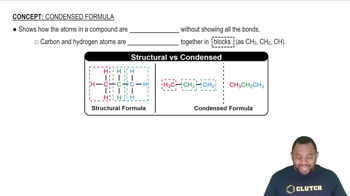
Condensed Formula

A condensed formula is a way of representing a chemical compound that shows the arrangement of atoms in a molecule without depicting all the bonds explicitly. It provides a simplified view of the molecular structure, indicating how atoms are grouped together. For example, in a condensed formula, carbon atoms are often listed in a linear fashion, with hydrogen atoms implied based on the tetravalency of carbon.
Recommended video:
Guided course
1:53
Condensed Formula Concept 1

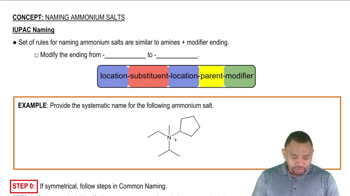
IUPAC Nomenclature

IUPAC nomenclature is a systematic method for naming chemical compounds, established by the International Union of Pure and Applied Chemistry. It provides rules for naming organic compounds based on their structure, including the identification of the longest carbon chain, substituents, and their positions. Understanding IUPAC nomenclature is essential for translating a compound's name into its corresponding chemical structure and condensed formula.
Recommended video:
Guided course
3:18
IUPAC Naming Concept 3

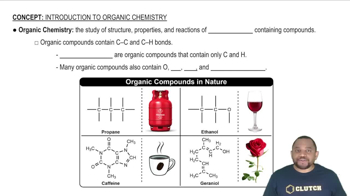
Substituents in Organic Chemistry

Substituents are atoms or groups of atoms that replace hydrogen atoms in a hydrocarbon chain. In the case of 1,3-dichloro-3-methylheptane, the substituents are two chlorine atoms and a methyl group attached to the heptane backbone. Recognizing the position and type of substituents is crucial for accurately writing the condensed formula and understanding the compound's chemical properties.
Recommended video:
Guided course
2:26
Introduction to Organic Chemistry Concept 1