Pearson+ LogoPearson+ Logo
Ch.5 Chemical Reactions
Frost - General, Organic and Biological Chemistry 4th Edition
Frost4th EditionGeneral, Organic and Biological ChemistryISBN: 9780134988696Not the one you use?Change textbook
Chapter 2, Problem 80

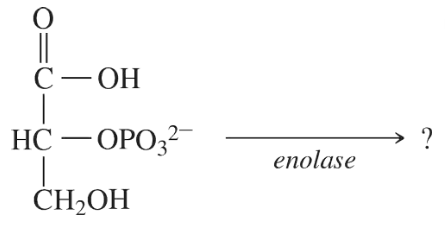
The reverse reaction of hydration is dehydration. The dehydration of an alcohol involves removing an OH from one carbon and an H from the carbon next to it to form an alkene. In glycolysis, the enzyme enolase catalyzes the dehydration of 2-phosphoglycerate to form phosphoenolpyruvate (PEP), which contains a carbon–carbon double bond. Complete the reaction below by drawing the structure of PEP.

Verified step by step guidance
1
Understand the concept of dehydration: Dehydration involves the removal of a water molecule (H₂O) from a compound. In this case, an OH group is removed from one carbon, and an H atom is removed from an adjacent carbon, resulting in the formation of a carbon-carbon double bond (alkene).
Analyze the reactant: The reactant in this reaction is 2-phosphoglycerate, which contains a hydroxyl group (-OH) on one carbon and a hydrogen atom on the adjacent carbon. These are the groups that will be removed during the dehydration process.
Identify the enzyme's role: The enzyme enolase catalyzes the dehydration reaction. Enzymes lower the activation energy of the reaction, making it proceed more efficiently. Enolase specifically facilitates the removal of the OH and H groups to form the double bond.
Determine the product structure: After the removal of the OH group from one carbon and the H atom from the adjacent carbon, a carbon-carbon double bond forms. The product, phosphoenolpyruvate (PEP), retains the phosphate group attached to one of the carbons.
Draw the structure of PEP: To complete the reaction, draw the structure of PEP, ensuring that it includes the carbon-carbon double bond, the phosphate group, and the correct connectivity of atoms. The double bond should be between the two carbons that lost the OH and H groups.

Verified video answer for a similar problem:

This video solution was recommended by our tutors as helpful for the problem above.
Video duration:
2m
Was this helpful?

Key Concepts

Here are the essential concepts you must grasp in order to answer the question correctly.

Dehydration Reaction

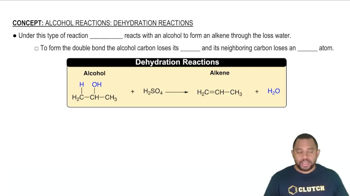
A dehydration reaction is a chemical process that involves the removal of water (H2O) from a molecule. In organic chemistry, this often occurs when an alcohol loses a hydroxyl group (OH) and a hydrogen atom (H) from adjacent carbon atoms, resulting in the formation of a carbon–carbon double bond, or alkene. This reaction is crucial in various metabolic pathways, including glycolysis.
Recommended video:
Guided course
1:30
Alcohol Reactions: Dehydration Reactions Concept 1

Glycolysis

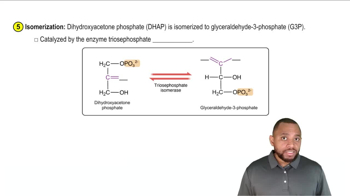
Glycolysis is a fundamental metabolic pathway that breaks down glucose into pyruvate, generating energy in the form of ATP and NADH. It consists of a series of enzymatic reactions, including the dehydration of 2-phosphoglycerate to phosphoenolpyruvate (PEP), which is catalyzed by the enzyme enolase. This pathway is essential for cellular respiration and energy production in both aerobic and anaerobic conditions.
Recommended video:
Guided course
1:26
Glycolysis Concept 5

Phosphoenolpyruvate (PEP)

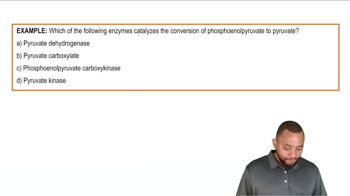
Phosphoenolpyruvate (PEP) is a high-energy compound formed during glycolysis, characterized by a carbon–carbon double bond and a phosphate group. It plays a critical role in the conversion of glucose to pyruvate and is a key intermediate in various metabolic processes. PEP is also involved in the synthesis of ATP through substrate-level phosphorylation, making it vital for energy metabolism.
Recommended video:
Guided course
1:31
Glycolysis Example 4