

Pearson+ LogoPearson+ Logo
Ch.6 Carbohydrates Life's Sweet Molecules
Frost - General, Organic and Biological Chemistry 4th Edition
Frost4th EditionGeneral, Organic and Biological ChemistryISBN: 9780134988696Not the one you use?Change textbook
Chapter 3, Problem 88

Carbohydrates are abbreviated using a three-letter abbreviation followed by their glycosidic bond type. For example, maltose and sucrose can be written respectively as

Provide the structure for the O-type blood carbohydrate set given the following abbreviation:
L-Fucα (1→2) Galß(1→4)GlcNAc

Verified step by step guidance
1
Step 1: Understand the abbreviation provided for the carbohydrate structure. The abbreviation L-Fucα (1→2) Galß (1→4) GlcNAc represents a carbohydrate chain where L-Fucose (L-Fuc) is linked to Galactose (Gal) via an alpha (α) glycosidic bond at position 1→2, and Galactose is linked to N-Acetylglucosamine (GlcNAc) via a beta (ß) glycosidic bond at position 1→4.
Step 2: Begin by drawing the structure of the first monosaccharide, L-Fucose (L-Fuc). L-Fucose is a six-carbon sugar with a methyl group (-CH3) attached to the carbon at position 6. Ensure the glycosidic bond at position 1 is oriented in the alpha (α) configuration.
Step 3: Next, draw the structure of the second monosaccharide, Galactose (Gal). Galactose is also a six-carbon sugar. Connect the anomeric carbon (carbon 1) of L-Fucose to the carbon at position 2 of Galactose via the alpha (α) glycosidic bond.
Step 4: Draw the structure of the third monosaccharide, N-Acetylglucosamine (GlcNAc). GlcNAc is a derivative of glucose with an acetyl group (-COCH3) attached to the nitrogen on carbon 2. Connect the anomeric carbon (carbon 1) of Galactose to the carbon at position 4 of GlcNAc via the beta (ß) glycosidic bond.
Step 5: Verify the orientation and connectivity of all glycosidic bonds (α for L-Fuc to Gal and ß for Gal to GlcNAc) and ensure the stereochemistry of each monosaccharide is correct. Label each sugar and glycosidic bond type clearly in your diagram.

Verified video answer for a similar problem:

This video solution was recommended by our tutors as helpful for the problem above.
Video duration:
9m
Was this helpful?

Key Concepts

Here are the essential concepts you must grasp in order to answer the question correctly.

Glycosidic Bonds

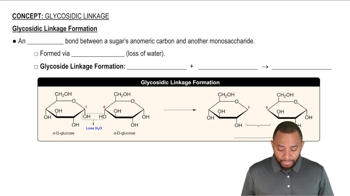
Glycosidic bonds are covalent linkages formed between carbohydrates, specifically between the anomeric carbon of one sugar and a hydroxyl group of another. The type of glycosidic bond, indicated by the configuration (α or ß) and the position (e.g., 1→2, 1→4), determines the structural and functional properties of the carbohydrate. Understanding these bonds is crucial for interpreting carbohydrate structures and their biological roles.
Recommended video:
Guided course
1:44
Glycosidic Linkage Formation Concept 1

Carbohydrate Abbreviations

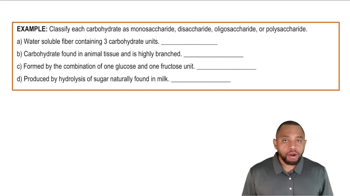
Carbohydrates are often represented using three-letter abbreviations that denote the specific sugar and its configuration. For example, 'Glc' stands for glucose, 'Gal' for galactose, and 'Fru' for fructose. These abbreviations simplify the representation of complex carbohydrate structures, making it easier to communicate and analyze their compositions and linkages in biochemical contexts.
Recommended video:
Guided course
1:29
Classification of Carbohydrates Example 1

Blood Group Carbohydrates

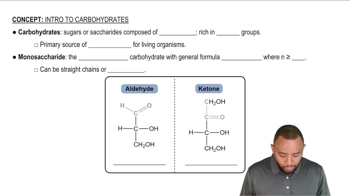
Blood group carbohydrates are specific oligosaccharides found on the surface of red blood cells that determine an individual's blood type. The O-type blood group is characterized by the presence of specific carbohydrate structures, including fucose, galactose, and N-acetylglucosamine, linked in a particular arrangement. Understanding these structures is essential for studying blood compatibility and transfusion medicine.
Recommended video:
Guided course
1:48
Intro to Carbohydrates Concept 1