Pearson+ LogoPearson+ Logo
Ch.6 Carbohydrates Life's Sweet Molecules
Frost - General, Organic and Biological Chemistry 4th Edition
Frost4th EditionGeneral, Organic and Biological ChemistryISBN: 9780134988696Not the one you use?Change textbook
Chapter 3, Problem 13a

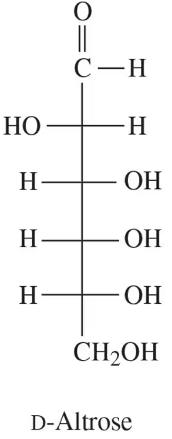
Draw the Fischer projection for the enantiomer (mirror image) of each of the following:
(a) Fischer projection of D-Altrose, showing its structural formula with hydroxyl and carbonyl groups.

Verified step by step guidance
1
Understand the Fischer projection: A Fischer projection is a two-dimensional representation of a three-dimensional molecule, where horizontal lines represent bonds projecting out of the plane (toward the viewer) and vertical lines represent bonds projecting into the plane (away from the viewer).
Identify the structure of d-Altrose: d-Altrose is a monosaccharide with a specific arrangement of hydroxyl (-OH) groups on its carbon chain. Refer to the provided image or standard structure of d-Altrose to determine the positions of the -OH groups and hydrogen atoms.
Draw the mirror image: To create the enantiomer, reverse the positions of all substituents on the chiral carbons. For each chiral carbon, swap the -OH group and the hydrogen atom on the horizontal bonds while keeping the vertical bonds unchanged.
Ensure proper orientation: Verify that the vertical bonds (representing the carbon backbone) remain consistent and that the horizontal bonds are correctly swapped to reflect the mirror image.
Label the enantiomer: Once the mirror image is drawn, label it as the enantiomer of d-Altrose. Double-check the configuration to ensure it is the correct mirror image representation.

Verified video answer for a similar problem:

This video solution was recommended by our tutors as helpful for the problem above.
Video duration:
1m
Was this helpful?

Key Concepts

Here are the essential concepts you must grasp in order to answer the question correctly.

Fischer Projection

The Fischer projection is a two-dimensional representation of a molecule that shows the configuration of its stereocenters. In this format, vertical lines represent bonds that extend behind the plane of the page, while horizontal lines represent bonds that extend in front. This method is particularly useful for visualizing carbohydrates and amino acids, allowing for easy identification of stereoisomers.
Recommended video:
Guided course
0:48
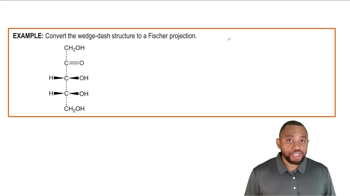
Fischer Projections Example 1

Enantiomers

Enantiomers are a type of stereoisomer that are non-superimposable mirror images of each other. They typically arise from molecules that contain one or more chiral centers, where the arrangement of atoms around the chiral center leads to two distinct configurations. Enantiomers often exhibit different optical activities, meaning they rotate plane-polarized light in opposite directions.
Recommended video:
Guided course
3:33
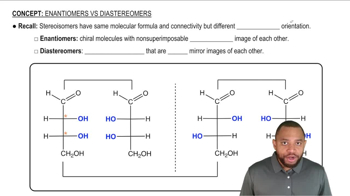
Enantiomers vs Diastereomers Concept 1

D- and L- Configuration

The D- and L- notation is used to designate the configuration of chiral molecules, particularly sugars and amino acids. The 'D' configuration indicates that the hydroxyl group on the highest-numbered chiral carbon is on the right in a Fischer projection, while 'L' indicates it is on the left. This system helps in categorizing sugars and understanding their biological roles, as well as their interactions with enzymes and receptors.
Recommended video:
Guided course
1:30
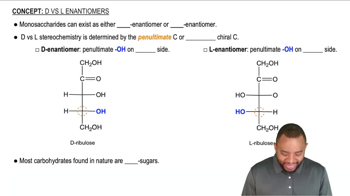
D vs L Enantiomers Concept 1