Pearson+ LogoPearson+ Logo
Ch.6 Carbohydrates Life's Sweet Molecules
Frost - General, Organic and Biological Chemistry 4th Edition
Frost4th EditionGeneral, Organic and Biological ChemistryISBN: 9780134988696Not the one you use?Change textbook
Chapter 3, Problem 11a

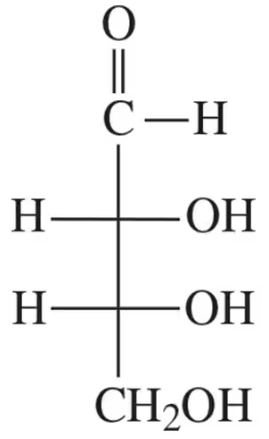
Identify the following monosaccharides as the D- or the L-isomer:
(a) Structural formula of a monosaccharide showing hydroxyl groups and a carbonyl group for D and L isomer identification.

Verified step by step guidance
1
Step 1: Understand the concept of D- and L-isomers. These are stereoisomers of monosaccharides that differ in the configuration of the hydroxyl group (-OH) on the chiral carbon farthest from the carbonyl group. In a Fischer projection, D-isomers have the hydroxyl group on the right, while L-isomers have it on the left.
Step 2: Examine the structure of the monosaccharide provided in the image. Locate the carbonyl group (either an aldehyde or ketone) and identify the chiral carbon farthest from it.
Step 3: Determine the position of the hydroxyl group (-OH) on the chiral carbon farthest from the carbonyl group. If the hydroxyl group is on the right side in the Fischer projection, it is a D-isomer. If it is on the left side, it is an L-isomer.
Step 4: Verify the configuration by comparing the structure to standard D- and L-isomer examples, ensuring the orientation matches the definition.
Step 5: Conclude whether the monosaccharide in the image is a D-isomer or an L-isomer based on the position of the hydroxyl group on the chiral carbon farthest from the carbonyl group.

Verified video answer for a similar problem:

This video solution was recommended by our tutors as helpful for the problem above.
Video duration:
1m
Was this helpful?

Key Concepts

Here are the essential concepts you must grasp in order to answer the question correctly.

Monosaccharides

Monosaccharides are the simplest form of carbohydrates, consisting of single sugar molecules like glucose and fructose. They serve as the building blocks for more complex carbohydrates and are crucial for energy production in living organisms. Understanding their structure and classification is essential for identifying their isomeric forms.
Recommended video:
Guided course
0:55
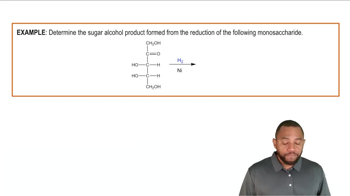
Reduction of Monosaccharides Example 1

D- and L- Isomers

D- and L- isomers refer to the two enantiomers of monosaccharides based on the orientation of the hydroxyl group (-OH) on the chiral carbon furthest from the carbonyl group. The 'D' designation indicates that the hydroxyl group is on the right in a Fischer projection, while 'L' indicates it is on the left. This classification is vital for understanding the biochemical behavior of sugars.
Recommended video:
Guided course
1:30
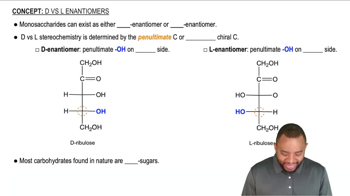
D vs L Enantiomers Concept 1

Fischer Projection

The Fischer projection is a two-dimensional representation of a molecule that illustrates the arrangement of atoms and functional groups. It is particularly useful for visualizing the stereochemistry of carbohydrates, allowing for easy identification of D- and L- isomers. Mastery of this projection is important for accurately determining the isomeric forms of monosaccharides.
Recommended video:
Guided course
0:48
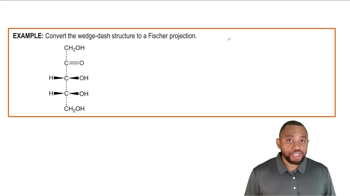
Fischer Projections Example 1