Pearson+ LogoPearson+ Logo
Ch.7 States of Matter and Their Attractive Forces
Frost - General, Organic and Biological Chemistry 4th Edition
Frost4th EditionGeneral, Organic and Biological ChemistryISBN: 9780134988696Not the one you use?Change textbook
Chapter 4, Problem 97

Mayonnaise is a thick mixture containing oil, vinegar (water-based), and eggs; the eggs contain a phospholipid molecule called lecithin. Mayonnaise cannot be made without lecithin. Explain why lecithin is a critical ingredient.

Verified step by step guidance
1
Lecithin is a type of phospholipid, which has a unique molecular structure consisting of a hydrophilic (water-attracting) head and hydrophobic (water-repelling) tails. This dual nature allows lecithin to act as an emulsifier.
An emulsifier is a substance that helps stabilize mixtures of oil and water, which normally do not mix due to their differing polarities. Oil is nonpolar, while water is polar, and lecithin bridges this gap.
The hydrophilic head of lecithin interacts with the water-based vinegar, while the hydrophobic tails interact with the oil, forming a stable emulsion. This prevents the oil and water from separating in the mixture.
Eggs, which contain lecithin, are added to mayonnaise to provide this emulsifying property, ensuring the mixture remains thick and uniform rather than separating into layers.
Without lecithin, the oil and water in mayonnaise would separate, making it impossible to achieve the desired consistency and texture of the final product.

Verified video answer for a similar problem:

This video solution was recommended by our tutors as helpful for the problem above.
Video duration:
1m
Was this helpful?

Key Concepts

Here are the essential concepts you must grasp in order to answer the question correctly.

Emulsification

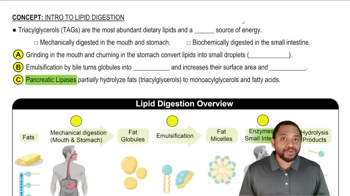
Emulsification is the process of mixing two immiscible liquids, such as oil and water, to create a stable mixture. In mayonnaise, lecithin acts as an emulsifier, allowing the oil and vinegar to blend smoothly. This is crucial for achieving the creamy texture characteristic of mayonnaise.
Recommended video:
Guided course
2:54
Intro to Lipid Digestion Concept 1

Lecithin

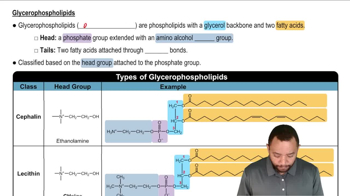
Lecithin is a phospholipid found in egg yolks that plays a vital role in emulsification. It has both hydrophilic (water-attracting) and hydrophobic (water-repelling) properties, which help to stabilize the mixture of oil and vinegar in mayonnaise. Without lecithin, the ingredients would separate, preventing the formation of a cohesive sauce.
Recommended video:
Guided course
1:56
Glycerophospholipids Concept 2

Stability of Emulsions

The stability of emulsions refers to the ability of a mixture to remain uniform over time without separating. In mayonnaise, lecithin contributes to this stability by reducing the surface tension between the oil and water phases, thus preventing separation. A stable emulsion is essential for the desired texture and shelf-life of mayonnaise.
Recommended video:
Guided course
02:26
Multiple Bonds Concept 1