Pearson+ LogoPearson+ Logo
Ch.7 States of Matter and Their Attractive Forces
Frost - General, Organic and Biological Chemistry 4th Edition
Frost4th EditionGeneral, Organic and Biological ChemistryISBN: 9780134988696Not the one you use?Change textbook
Chapter 4, Problem 46

Draw a possible hydrogen bond between a molecule of cholesterol and a molecule of water.

Verified step by step guidance
1
Identify the functional groups in cholesterol that can participate in hydrogen bonding. Cholesterol contains a hydroxyl (-OH) group, which is capable of forming hydrogen bonds due to the presence of a hydrogen atom bonded to an electronegative oxygen atom.
Understand the nature of hydrogen bonding. A hydrogen bond occurs when a hydrogen atom covalently bonded to an electronegative atom (like oxygen or nitrogen) interacts with another electronegative atom that has lone pairs of electrons.
Locate the water molecule's structure. Water (H₂O) has two lone pairs of electrons on the oxygen atom and two hydrogen atoms that can participate in hydrogen bonding.
Draw the interaction between the hydroxyl group of cholesterol and the water molecule. The hydrogen atom of the hydroxyl group in cholesterol can form a hydrogen bond with one of the lone pairs on the oxygen atom of the water molecule.
Ensure proper orientation in the drawing. The hydrogen bond should be represented as a dashed line between the hydrogen atom of the hydroxyl group in cholesterol and the oxygen atom of the water molecule, showing the interaction clearly.

Verified video answer for a similar problem:

This video solution was recommended by our tutors as helpful for the problem above.
Video duration:
5m
Was this helpful?

Key Concepts

Here are the essential concepts you must grasp in order to answer the question correctly.

Hydrogen Bonding

Hydrogen bonding is a type of weak chemical bond that occurs when a hydrogen atom covalently bonded to a highly electronegative atom, such as oxygen or nitrogen, experiences an attraction to another electronegative atom. In the context of cholesterol and water, the hydrogen atoms in water can form hydrogen bonds with the oxygen atoms in cholesterol, facilitating interactions between these molecules.
Recommended video:
Guided course
1:22
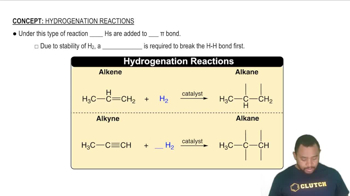
Hydrogenation Reactions Concept 1

Cholesterol Structure

Cholesterol is a lipid molecule characterized by a complex structure that includes a hydrophobic steroid ring system and a small hydrophilic hydroxyl group. This unique structure allows cholesterol to interact with both hydrophobic and hydrophilic environments, making it essential for membrane fluidity and stability in biological systems, as well as influencing its interactions with water molecules.
Recommended video:
Guided course
1:01
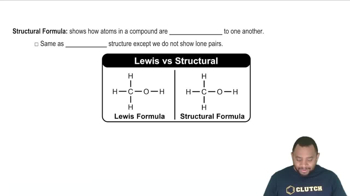
Structural Formula Concept 2

Polarity of Water

Water is a polar molecule, meaning it has a partial positive charge on one side (due to hydrogen atoms) and a partial negative charge on the other side (due to the oxygen atom). This polarity enables water to form hydrogen bonds with other polar molecules, such as cholesterol, which enhances solubility and interaction in biological systems, playing a crucial role in biochemical processes.
Recommended video:
Guided course
01:34
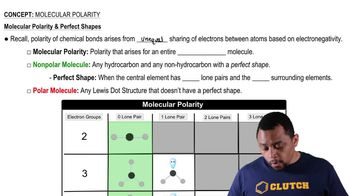
Molecular Polarity (Simplified) Concept 1