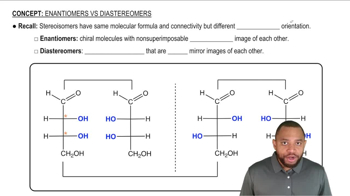
A white solid with a melting point of 730 °C is melted. When electricity is passed through the resultant liquid, a brown gas and a molten metal are produced. Neither the metal nor the gas can be broken down into anything simpler by chemical means. Classify each—the white solid, the molten metal, and the brown gas—as a mixture, a compound, or an element.
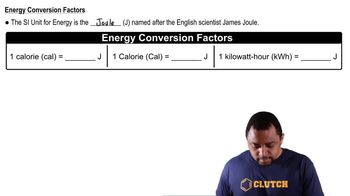
The relationship between the nutritional unit for energy and the metric unit is 1 Calorie = 1 kcal.
a. One donut contains 350 Calories. Convert this to calories and joules.
Verified step by step guidance
Verified video answer for a similar problem:
Key Concepts
Calorie vs. Kilocalorie
Energy Conversion
Nutritional Energy Content
Refer to the pencil in Problem 1.31. Using the equivalent values in Table 1.8 as conversion factors, convert the length measured in inches to centimeters. Compare the calculated length in centimeters to the length in centimeters measured using the metric ruler. How do the two values compare? Explain any differences.
<IMAGE>
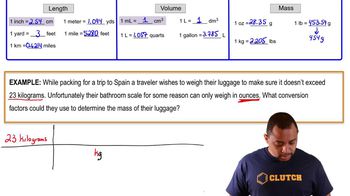
Gemstones are weighed in carats, where 1 carat = 200 mg exactly. What is the mass in grams of the Hope diamond, the world's largest blue diamond, at 44.4 carats?
Today, thermometers containing mercury are used less frequently than in the past because of concerns regarding the toxicity of mercury and because of its relatively high melting point (-39 °C). This means that mercury thermometers cannot be used in very cold environments because the mercury is a solid under such conditions. Alcohol thermometers, however, can be used over a temperature range from -115 °C (the melting point of alcohol) to 78.5 °C (the boiling point of alcohol).
b. The densities of alcohol and mercury are 0.79 g/mL and 13.6 g/mL, respectively. If the volume of liquid in a typical laboratory thermometer is 1.0 mL, what mass of alcohol is contained in the thermometer? What mass of mercury?

A patient is receiving 3000 mL/day of a solution that contains 5 g of dextrose (glucose) per 100 mL of solution. If glucose provides 4 kcal/g of energy, how many kilocalories per day is the patient receiving from the glucose?
When 1.0 tablespoon of butter is burned or used by our body, it releases 100 kcal (100 food Calories or 418.4 kJ) of energy. If we could use all the energy provided, how many tablespoons of butter would have to be burned to raise the temperature of 3.00 L of water from 18.0 ℃ to 90.0 ℃