Pearson+ LogoPearson+ Logo
Ch.1 Matter and Measurements
McMurry - Fundamentals of GOB 8th Edition
McMurry8th EditionFundamentals of GOBISBN: 9780134015187Not the one you use?Change textbook
Chapter 1, Problem 85

When 100 cal (418 J) of heat is applied to a 125 g sample, the temperature increases by 28 °C. Calculate the specific heat of the sample and compare your answer to the values in Table 1.10. What is the identity of the sample?

Verified step by step guidance
1
Step 1: Recall the formula for specific heat capacity: c = qmΔT, where q is the heat energy applied, m is the mass of the sample, and ΔT is the change in temperature.
Step 2: Identify the given values from the problem: q = 418 \, J, m = 125 \, g, and ΔT = 28 \, ^{\circ}C.
Step 3: Substitute the given values into the formula: c = 41812528. Perform the division in the denominator first, then divide 418 by the result.
Step 4: Compare the calculated specific heat value to the values in Table 1.10. Look for a material with a specific heat value close to your result to identify the sample.
Step 5: Conclude the identity of the sample based on the comparison. For example, if the specific heat matches that of aluminum, the sample is likely aluminum.

Verified video answer for a similar problem:

This video solution was recommended by our tutors as helpful for the problem above.
Video duration:
1m
Was this helpful?

Key Concepts

Here are the essential concepts you must grasp in order to answer the question correctly.

Specific Heat Capacity

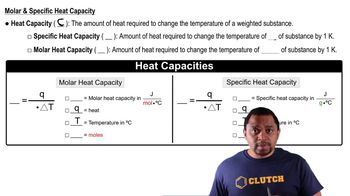
Specific heat capacity is the amount of heat required to raise the temperature of one gram of a substance by one degree Celsius. It is a material-specific property that helps in understanding how different substances respond to heat. The formula to calculate specific heat (c) is c = Q / (m * ΔT), where Q is the heat added, m is the mass, and ΔT is the change in temperature.
Recommended video:
Guided course
02:19
Heat Capacity

Heat Transfer

Heat transfer refers to the movement of thermal energy from one object or substance to another due to a temperature difference. In this context, heat is applied to the sample, causing its temperature to rise. Understanding the principles of heat transfer is essential for calculating specific heat and analyzing thermal properties of materials.
Recommended video:
Guided course
02:19
Heat Capacity

Material Identification

Material identification involves comparing the calculated specific heat of a sample with known values in reference tables. Each substance has a characteristic specific heat, which can be used to identify it. By determining the specific heat from the experiment and comparing it to standard values, one can infer the identity of the material in question.
Recommended video:
Guided course
07:46
Laboratory Materials 2
Related Practice
Textbook Question

The white blood cell concentration in normal blood is approximately 12,000 cells/mm3 of blood. How many white blood cells does a normal adult with 5 L of blood have? Express the answer in scientific notation.

1652
views
1
rank
Textbook Question

Calculate the specific heat of copper if it takes 23 cal (96 J) to heat a 5.0 g sample from 25 °C to 75 °C.

1674
views
Textbook Question

The specific heat of fat is 0.45 cal/(g ⋅ °C) (1.9 J/g °C) and the density of fat is 0.94 g/cm3. How much energy (in calories and joules) is needed to heat 10 cm3 of fat from room temperature (25 °C) to its melting point (35 °C)?

2550
views
1
rank
Textbook Question

A white solid with a melting point of 730 °C is melted. When electricity is passed through the resultant liquid, a brown gas and a molten metal are produced. Neither the metal nor the gas can be broken down into anything simpler by chemical means. Classify each—the white solid, the molten metal, and the brown gas—as a mixture, a compound, or an element.

1611
views
Textbook Question

Refer to the pencil in Problem 1.31. Using the equivalent values in Table 1.8 as conversion factors, convert the length measured in inches to centimeters. Compare the calculated length in centimeters to the length in centimeters measured using the metric ruler. How do the two values compare? Explain any differences.

<IMAGE>

1859
views
Textbook Question

Gemstones are weighed in carats, where 1 carat = 200 mg exactly. What is the mass in grams of the Hope diamond, the world's largest blue diamond, at 44.4 carats?

1522
views