Pearson+ LogoPearson+ Logo
Ch.10 Acids and Bases
McMurry - Fundamentals of GOB 8th Edition
McMurry8th EditionFundamentals of GOBISBN: 9780134015187Not the one you use?Change textbook
Chapter 10, Problem 111a

Many allergy medications contain antihistamines, compounds that contain amine groups (R-NH2, where R refers to an organic functional group). Would you expect these compounds to be acidic, basic or neutral? Explain.
a. One over-the-counter product lists the active ingredient as "diphenhydramine HCl." What does this designation mean?

Verified step by step guidance
1
Step 1: Begin by analyzing the chemical structure of amine groups (R-NH₂). Amines are nitrogen-containing compounds where the nitrogen atom has a lone pair of electrons. This lone pair allows amines to act as proton acceptors, making them basic in nature.
Step 2: Consider the designation 'diphenhydramine HCl.' The 'HCl' indicates that the compound is in its hydrochloride salt form. This is common for amine-containing drugs, as the amine group reacts with hydrochloric acid (HCl) to form a salt, which improves the compound's solubility in water.
Step 3: Understand the reaction between the amine group and HCl. The amine group (R-NH₂) acts as a base and accepts a proton (H⁺) from HCl, forming the ammonium ion (R-NH₃⁺). This process neutralizes the basicity of the amine group, resulting in a salt form.
Step 4: Evaluate the acidity, basicity, or neutrality of the compound. In its hydrochloride salt form, diphenhydramine HCl is neutral because the basic amine group has been protonated and paired with the chloride ion (Cl⁻), balancing the charge.
Step 5: Conclude that while amines are typically basic, the presence of 'HCl' in diphenhydramine HCl indicates that the compound has been converted into a neutral salt form for pharmaceutical use.

Verified video answer for a similar problem:

This video solution was recommended by our tutors as helpful for the problem above.
Video duration:
2m
Was this helpful?

Key Concepts

Here are the essential concepts you must grasp in order to answer the question correctly.

Antihistamines and Amine Groups

Antihistamines are compounds that block the action of histamine, a substance in the body that causes allergic symptoms. Many antihistamines contain amine groups (R-NH₂), which are basic due to the presence of a nitrogen atom that can accept protons. This basicity influences their interaction with biological systems and their overall pharmacological effects.
Recommended video:
Guided course
0:54
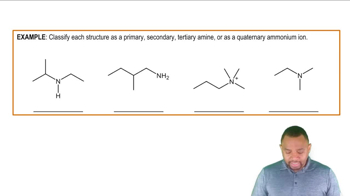
Amine Classification Example 1

Acidity and Basicity of Compounds

The acidity or basicity of a compound is determined by its ability to donate or accept protons (H⁺ ions). Compounds with amine groups are generally considered basic because they can accept protons, leading to a positive charge. Understanding this property is crucial for predicting the behavior of antihistamines in the body and their effectiveness in treating allergies.
Recommended video:
Guided course
01:04
Balancing Redox Reactions: Basic Solutions

Diphenhydramine HCl Designation

The designation 'diphenhydramine HCl' indicates that diphenhydramine is combined with hydrochloric acid to form a salt. This salt form enhances the solubility and stability of the drug, making it easier to administer and absorb in the body. The 'HCl' signifies that the diphenhydramine is in its hydrochloride form, which is common for many pharmaceutical compounds.
Recommended video:
Guided course
02:41
Buffer Solution Example