Pearson+ LogoPearson+ Logo
Ch.10 Acids and Bases
McMurry - Fundamentals of GOB 8th Edition
McMurry8th EditionFundamentals of GOBISBN: 9780134015187Not the one you use?Change textbook
Chapter 10, Problem 76a

The pH of a buffer solution containing 0.10 M acetic acid and 0.10 M sodium acetate is 4.74.
a. Write the Henderson–Hasselbalch equation for this buffer.

Verified step by step guidance
1
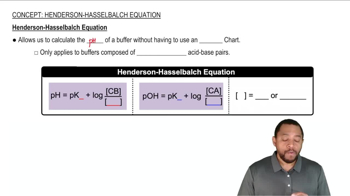
The Henderson–Hasselbalch equation is used to calculate the pH of a buffer solution. It is expressed as: pH=pKa+log([A][HA]), where pKa is the negative logarithm of the acid dissociation constant, Ka, [A⁻] is the concentration of the conjugate base, and [HA] is the concentration of the weak acid.
Identify the components of the buffer solution: acetic acid (CH₃COOH) is the weak acid (HA), and sodium acetate (CH₃COONa) provides the conjugate base (A⁻).
Substitute the given concentrations into the equation. For this buffer, [HA] = 0.10 M and [A⁻] = 0.10 M. The equation becomes: pH=pKa+log(0.100.10).
Simplify the logarithmic term. Since the concentrations of the acid and conjugate base are equal, the ratio [A⁻]/[HA] = 1. The logarithm of 1 is 0, so the equation simplifies to: pH=pKa.
The pH of the buffer is given as 4.74, which means the pKa of acetic acid is also 4.74. This confirms the relationship described by the Henderson–Hasselbalch equation.

Verified video answer for a similar problem:

This video solution was recommended by our tutors as helpful for the problem above.
Video duration:
1m
Was this helpful?

Key Concepts

Here are the essential concepts you must grasp in order to answer the question correctly.

Henderson-Hasselbalch Equation

The Henderson-Hasselbalch equation is a mathematical formula used to calculate the pH of a buffer solution. It relates the pH of the solution to the pKa of the acid and the ratio of the concentrations of the conjugate base to the acid. The equation is expressed as pH = pKa + log([A-]/[HA]), where [A-] is the concentration of the base and [HA] is the concentration of the acid.
Recommended video:
Guided course
01:22
Henderson-Hasselbalch Equation

Buffer Solutions

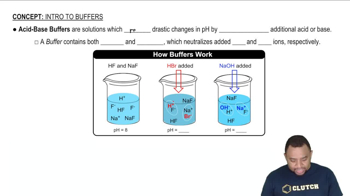
Buffer solutions are mixtures that resist changes in pH when small amounts of acid or base are added. They typically consist of a weak acid and its conjugate base or a weak base and its conjugate acid. In this case, acetic acid (a weak acid) and sodium acetate (its conjugate base) form a buffer that maintains a stable pH around 4.74.
Recommended video:
Guided course
03:02
Buffer Solutions

pKa and Acid-Base Equilibrium

The pKa is the negative logarithm of the acid dissociation constant (Ka) and indicates the strength of an acid in solution. It is a crucial value in the Henderson-Hasselbalch equation, as it helps determine the pH of a buffer. For acetic acid, the pKa is approximately 4.76, which is close to the given pH of the buffer, indicating effective buffering capacity.
Recommended video:
Guided course
03:43
The Equilibrium Constant Example 1