How does normality compare to molarity for monoprotic and polyprotic acids?
Verified step by step guidance
1
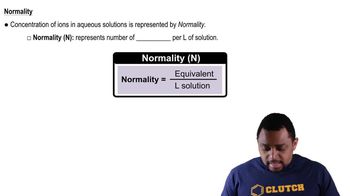
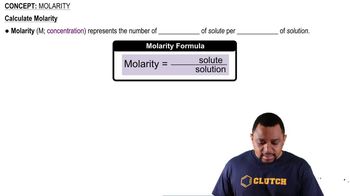
Understand the definitions: Molarity (M) is the number of moles of solute per liter of solution, while Normality (N) is the number of equivalents of solute per liter of solution. An equivalent depends on the reaction being studied, such as the number of protons (H⁺) an acid can donate.
For monoprotic acids (e.g., HCl): Each molecule of the acid donates one proton (H⁺) in a reaction. Therefore, the number of equivalents is equal to the number of moles. In this case, Normality (N) is equal to Molarity (M).
For polyprotic acids (e.g., H₂SO₄): Each molecule of the acid can donate more than one proton (H⁺). For example, sulfuric acid (H₂SO₄) can donate two protons. In this case, the Normality (N) is equal to the Molarity (M) multiplied by the number of protons the acid can donate. Mathematically, N = M × number of protons donated.
To calculate Normality for a polyprotic acid, identify the number of protons the acid can donate in the reaction. For example, if 1 M H₂SO₄ is fully dissociated, it will have a Normality of 2 N because it donates 2 protons per molecule.
Summarize the relationship: For monoprotic acids, Normality equals Molarity (N = M). For polyprotic acids, Normality is greater than Molarity and is calculated as N = M × number of protons donated.
Verified video answer for a similar problem:
This video solution was recommended by our tutors as helpful for the problem above
Video duration:
3m
Play a video:
Was this helpful?
Key Concepts
Here are the essential concepts you must grasp in order to answer the question correctly.
Normality
Normality is a measure of concentration equivalent to the number of equivalents of solute per liter of solution. It is particularly useful in acid-base reactions, where it accounts for the reactive capacity of an acid or base. For monoprotic acids, which donate one proton per molecule, normality equals molarity. However, for polyprotic acids, which can donate multiple protons, normality can be greater than molarity, reflecting the total number of protons available for reaction.
Molarity is defined as the number of moles of solute per liter of solution. It is a fundamental unit of concentration in chemistry, allowing for the quantification of solute in a given volume. Molarity does not consider the reactivity of the solute, making it a straightforward measure for solutions. In the context of acids, molarity provides a basis for understanding the concentration of the acid itself, regardless of its ability to donate protons.
Monoprotic acids are acids that can donate only one proton (H+) per molecule, such as hydrochloric acid (HCl). In contrast, polyprotic acids can donate more than one proton; for example, sulfuric acid (H2SO4) can donate two protons. This distinction is crucial when comparing normality and molarity, as the normality of polyprotic acids can be significantly higher than their molarity due to the multiple protons they can release in solution.