Rearrange the equation you wrote in Problem 10.50 to solve for [H3O+] in terms of Ka.
Verified step by step guidance
1
Start with the general expression for the acid dissociation constant (Kₐ), which is defined as: , where [H₃O⁺] is the hydronium ion concentration, [A⁻] is the conjugate base concentration, and [HA] is the concentration of the weak acid.
Rearrange the equation to isolate [H₃O⁺] on one side. Multiply both sides of the equation by [HA] to eliminate the denominator: .
Next, divide both sides of the equation by [A⁻] to solve for [H₃O⁺]: .
Interpret the result: The equation now expresses [H₃O⁺] in terms of the acid dissociation constant (Kₐ), the concentration of the weak acid ([HA]), and the concentration of the conjugate base ([A⁻]).
To apply this equation, substitute the known values for Kₐ, [HA], and [A⁻] into the formula and calculate [H₃O⁺]. Ensure that the units are consistent throughout the calculation.
Verified video answer for a similar problem:
This video solution was recommended by our tutors as helpful for the problem above
Video duration:
2m
Play a video:
Was this helpful?
Key Concepts
Here are the essential concepts you must grasp in order to answer the question correctly.
Equilibrium Constant (Kₐ)
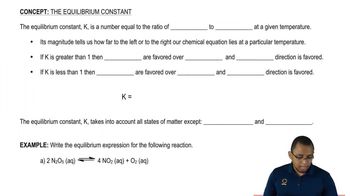
The acid dissociation constant (Kₐ) quantifies the strength of an acid in solution. It is defined as the ratio of the concentration of the products to the concentration of the reactants at equilibrium, specifically for the dissociation of an acid into its ions. A higher Kₐ value indicates a stronger acid that dissociates more completely in solution.
The concentration of hydronium ions ([H₃O⁺]) in a solution is a measure of its acidity. It is derived from the dissociation of acids in water, where an acid donates a proton (H⁺) to water, forming H₃O⁺. Understanding how to express [H₃O⁺] in terms of Kₐ is crucial for calculating pH and assessing the strength of acids.
Rearranging equations involves manipulating algebraic expressions to isolate a specific variable. In this context, solving for [H₃O⁺] in terms of Kₐ requires applying algebraic techniques such as addition, subtraction, multiplication, and division to express the desired variable clearly. Mastery of this skill is essential for solving chemical equilibrium problems.