
Pearson+ LogoPearson+ Logo
Ch.11 Nuclear Chemistry
McMurry - Fundamentals of GOB 8th Edition
McMurry8th EditionFundamentals of GOBISBN: 9780134015187Not the one you use?Change textbook
Chapter 11, Problem 68b

A selenium-75 source is producing 300 rem at a distance of 2.0 m?
b. What is its intensity at 25 m?

Verified step by step guidance
1
Step 1: Understand the problem. The intensity of radiation follows the inverse square law, which states that the intensity of radiation is inversely proportional to the square of the distance from the source. Mathematically, this is expressed as: I_1/I_2 = (d_2/d_1)^2, where I_1 and I_2 are the intensities at distances d_1 and d_2, respectively.
Step 2: Identify the given values. From the problem, we know: I_1 = 300 \, \text{rem}, d_1 = 2.0 \, \text{m}, and d_2 = 25 \, \text{m}. We need to calculate I_2, the intensity at 25 m.
Step 3: Rearrange the inverse square law formula to solve for I_2. The formula becomes: I_2 = I_1 \cdot \left(\frac{d_1}{d_2}\right)^2.
Step 4: Substitute the known values into the formula. Replace I_1 with 300 rem, d_1 with 2.0 m, and d_2 with 25 m. The equation becomes: I_2 = 300 \cdot \left(\frac{2.0}{25}\right)^2.
Step 5: Simplify the expression to calculate I_2. First, calculate the fraction \frac{2.0}{25}, then square the result, and finally multiply by 300 to find the intensity at 25 m.

Verified video answer for a similar problem:

This video solution was recommended by our tutors as helpful for the problem above.
Video duration:
1m
Was this helpful?

Key Concepts

Here are the essential concepts you must grasp in order to answer the question correctly.

Radiation Intensity

Radiation intensity refers to the power per unit area carried by a wave, typically measured in watts per square meter (W/m²). In the context of radiation sources, intensity decreases with distance from the source due to the inverse square law, which states that intensity is inversely proportional to the square of the distance from the source.
Recommended video:
Guided course
02:45
Intensive vs. Extensive Properties

Inverse Square Law

The inverse square law is a fundamental principle in physics that describes how a physical quantity (like light or radiation) decreases as the distance from the source increases. Specifically, if the distance from the source doubles, the intensity becomes one-fourth of its original value. This law is crucial for calculating changes in intensity at different distances.
Recommended video:
Guided course
04:24
Inverse Logarithmic Functions

Radiation Measurement Units

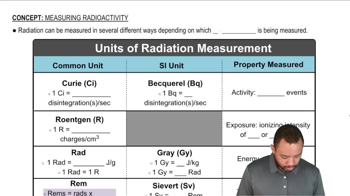
Radiation is often measured in units such as rem (roentgen equivalent man), which quantifies the biological effect of ionizing radiation on human tissue. Understanding these units is essential for interpreting radiation exposure and its potential health impacts, as well as for converting between different measurement systems when calculating intensity.
Recommended video:
Guided course
02:52
Measuring Radioactivity Concept 1