Pearson+ LogoPearson+ Logo
Ch.11 Nuclear Chemistry
McMurry - Fundamentals of GOB 8th Edition
McMurry8th EditionFundamentals of GOBISBN: 9780134015187Not the one you use?Change textbook
Chapter 11, Problem 54

What does it mean when we say that strontium-90, a waste product of nuclear power plants, has a half-life of 28.8 years?

Verified step by step guidance
1
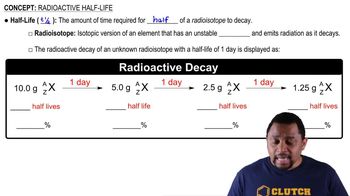
Understand the concept of half-life: The half-life of a radioactive isotope is the time it takes for half of the radioactive nuclei in a sample to decay into a more stable form.
Relate the half-life to strontium-90: When we say that strontium-90 has a half-life of 28.8 years, it means that after 28.8 years, half of the original amount of strontium-90 will have decayed into its daughter isotopes.
Express this mathematically: The decay of a radioactive isotope can be modeled using the equation \( N_t = N_0 \cdot e^{-kt} \), where \( N_t \) is the amount remaining at time \( t \), \( N_0 \) is the initial amount, \( k \) is the decay constant, and \( t \) is time.
Relate the decay constant to the half-life: The decay constant \( k \) is related to the half-life \( t_{1/2} \) by the formula \( k = \frac{\ln(2)}{t_{1/2}} \). For strontium-90, \( t_{1/2} = 28.8 \) years.
Interpret the significance: This means that if you start with a certain amount of strontium-90, after 28.8 years, only half of it will remain. After another 28.8 years (a total of 57.6 years), only one-quarter of the original amount will remain, and so on.

Verified video answer for a similar problem:

This video solution was recommended by our tutors as helpful for the problem above.
Video duration:
1m
Was this helpful?

Key Concepts

Here are the essential concepts you must grasp in order to answer the question correctly.

Half-Life

Half-life is the time required for half of the radioactive atoms in a sample to decay. For strontium-90, a half-life of 28.8 years means that after this period, only half of the original amount of strontium-90 will remain, while the other half has transformed into a different element or isotope through radioactive decay.
Recommended video:
Guided course
02:09
Radioactive Half-Life Concept 1

Radioactive Decay

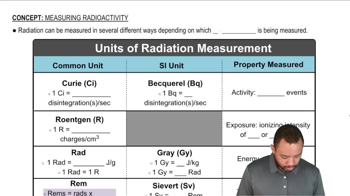
Radioactive decay is the process by which unstable atomic nuclei lose energy by emitting radiation. This can occur in various forms, including alpha, beta, or gamma decay. Strontium-90 undergoes beta decay, where it transforms into a more stable isotope, releasing beta particles in the process.
Recommended video:
Guided course
02:52
Measuring Radioactivity Concept 1

Nuclear Waste Management

Nuclear waste management involves the processes of handling, storing, and disposing of radioactive waste produced by nuclear power plants. Understanding the half-life of isotopes like strontium-90 is crucial for determining safe storage durations and methods, as the waste remains hazardous for many years due to its long half-life.
Recommended video:
Guided course
04:23
Alpha Decay Concept 1