Pearson+ LogoPearson+ Logo
Ch.11 Nuclear Chemistry
McMurry - Fundamentals of GOB 8th Edition
McMurry8th EditionFundamentals of GOBISBN: 9780134015187Not the one you use?Change textbook
Chapter 11, Problem 42

How does nuclear fission differ from normal radioactive decay?

Verified step by step guidance
1
Nuclear fission is a process in which a heavy nucleus (such as uranium-235 or plutonium-239) splits into two smaller nuclei, along with the release of a significant amount of energy and additional neutrons. In contrast, normal radioactive decay involves the spontaneous transformation of an unstable nucleus into a more stable one by emitting particles (like alpha or beta particles) or radiation (like gamma rays).
In nuclear fission, the process is typically initiated by the absorption of a neutron by the heavy nucleus, which makes it unstable and causes it to split. Radioactive decay, however, occurs naturally without external triggers and is governed by the inherent instability of the nucleus.
The products of nuclear fission are two smaller nuclei (called fission fragments), free neutrons, and energy. In radioactive decay, the products depend on the type of decay: for example, alpha decay produces a helium nucleus, beta decay produces an electron or positron, and gamma decay releases electromagnetic radiation.
Nuclear fission can lead to a chain reaction if the released neutrons are absorbed by other fissile nuclei, causing them to undergo fission as well. Radioactive decay does not involve chain reactions; it occurs at a fixed rate determined by the half-life of the isotope.
The energy released in nuclear fission is much greater than that released in normal radioactive decay. This is why fission is used in nuclear reactors and weapons, while radioactive decay is typically used in applications like medical imaging and radiometric dating.

Verified video answer for a similar problem:

This video solution was recommended by our tutors as helpful for the problem above.
Video duration:
2m
Was this helpful?

Key Concepts

Here are the essential concepts you must grasp in order to answer the question correctly.

Nuclear Fission

Nuclear fission is a process in which the nucleus of an atom splits into two or more smaller nuclei, along with the release of a significant amount of energy. This reaction typically occurs in heavy elements like uranium or plutonium when they absorb a neutron. Fission is a controlled reaction used in nuclear reactors and an uncontrolled reaction in nuclear weapons.
Recommended video:
Guided course
02:06
Types of Radiation Concept 1

Radioactive Decay

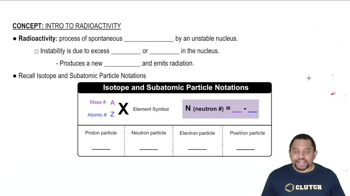
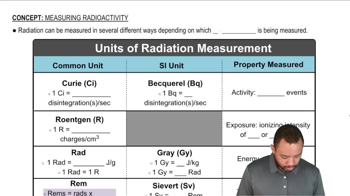
Radioactive decay is a natural process by which unstable atomic nuclei lose energy by emitting radiation, resulting in the transformation of the original atom into a different element or isotope. This process occurs at a characteristic rate for each radioactive isotope, defined by its half-life, and can involve alpha, beta, or gamma decay.
Recommended video:
Guided course
02:52
Measuring Radioactivity Concept 1

Energy Release Mechanisms

The mechanisms of energy release in nuclear fission and radioactive decay differ significantly. In fission, energy is released due to the conversion of mass into energy as described by Einstein's equation E=mc², while in radioactive decay, energy is released primarily through the emission of particles and radiation as the nucleus transitions to a more stable state. This distinction is crucial for understanding the applications and implications of each process.
Recommended video: