Pearson+ LogoPearson+ Logo
Ch.11 Nuclear Chemistry
McMurry - Fundamentals of GOB 8th Edition
McMurry8th EditionFundamentals of GOBISBN: 9780134015187Not the one you use?Change textbook
Chapter 11, Problem 36

How can a nucleus emit an electron during β decay when there are no electrons present in the nucleus to begin with?

Verified step by step guidance
1
Understand the concept of β decay: Beta (β) decay is a type of radioactive decay in which a nucleus emits a beta particle. A beta particle can either be an electron (β⁻ decay) or a positron (β⁺ decay). In this case, we are discussing β⁻ decay, where an electron is emitted.
Recognize the source of the emitted electron: During β⁻ decay, a neutron in the nucleus is converted into a proton, an electron, and an antineutrino. This process occurs due to the weak nuclear force, one of the four fundamental forces in nature.
Write the reaction for β⁻ decay: The conversion of a neutron into a proton can be represented as: np+e+ν¯. Here, e represents the emitted electron, and ν¯ is the antineutrino.
Clarify why the electron is emitted: The electron emitted during β⁻ decay is not one that was originally present in the nucleus. Instead, it is created during the transformation of the neutron into a proton. This is a result of the conservation of charge and energy during the decay process.
Summarize the key takeaway: The nucleus emits an electron during β⁻ decay because the electron is produced as a byproduct of the neutron-to-proton conversion. This process is governed by the weak nuclear force and ensures the conservation of fundamental properties like charge and energy.

Verified video answer for a similar problem:

This video solution was recommended by our tutors as helpful for the problem above.
Video duration:
2m
Was this helpful?

Key Concepts

Here are the essential concepts you must grasp in order to answer the question correctly.

Beta Decay

Beta decay is a type of radioactive decay in which a nucleus emits a beta particle, which can be an electron or a positron. This process occurs when a neutron in the nucleus transforms into a proton, emitting an electron (beta-minus decay) and an antineutrino. The emitted electron is not pre-existing in the nucleus; rather, it is created during the decay process.
Recommended video:
Guided course
06:46
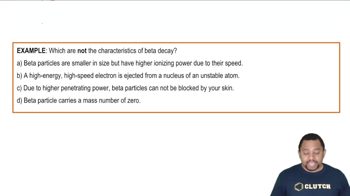
Beta Decay Example 2

Weak Nuclear Force

The weak nuclear force is one of the four fundamental forces of nature and is responsible for processes like beta decay. It governs the interactions that allow particles to change types, such as a neutron converting into a proton and emitting a beta particle. This force operates at a very short range and is crucial for the stability and transformation of subatomic particles.
Recommended video:
Guided course
01:59
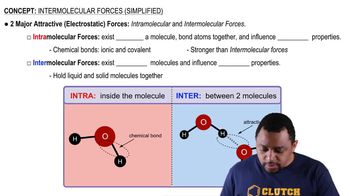
Intermolecular Forces (Simplified) Concept 1

Particle-Antiparticle Creation

In quantum physics, particle-antiparticle pairs can be created from energy, as described by Einstein's equation E=mc². During beta decay, the energy released from the transformation of a neutron into a proton can facilitate the creation of an electron and an antineutrino. This illustrates how particles can emerge from energy fluctuations in the quantum field, even if they were not present initially.
Recommended video:
Guided course
01:25
Subatomic Particles (Simplified) Concept 1