Pearson+ LogoPearson+ Logo
Ch.5 Classification & Balancing of Chemical Reactions
McMurry - Fundamentals of GOB 8th Edition
McMurry8th EditionFundamentals of GOBISBN: 9780134015187Not the one you use?Change textbook
Chapter 5, Problem 16

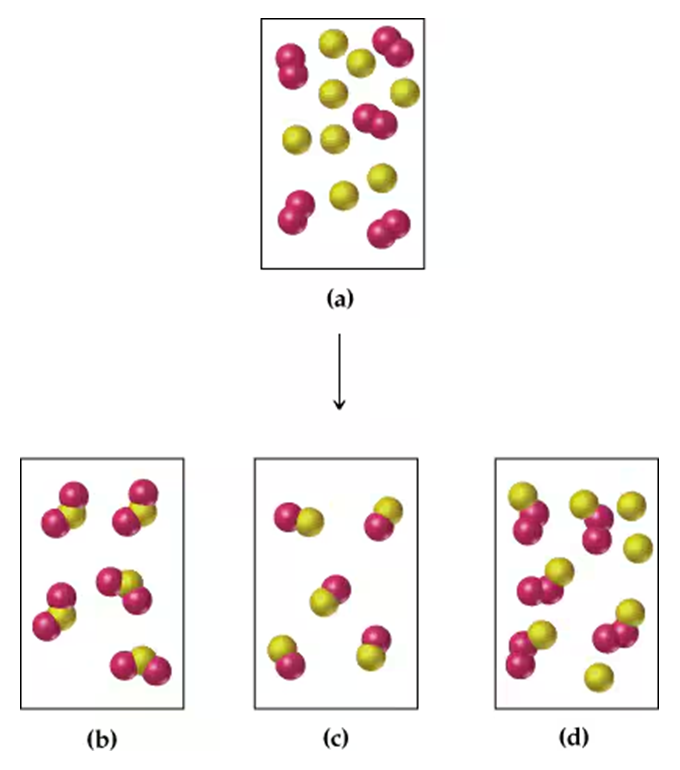
Assume that the mixture of substances in drawing (a) undergoes a reaction. Which of the drawings (b)–(d) represent a product mixture consistent with the law of conservation of mass?

Verified step by step guidance
1
Step 1: Analyze the initial mixture in drawing (a). Count the number of red spheres and blue spheres. Note that red spheres represent one type of atom or molecule, and blue spheres represent another type.
Step 2: Apply the law of conservation of mass, which states that the total number of atoms must remain constant before and after the reaction. This means the number of red and blue spheres in the product mixture must equal the number in the reactant mixture.
Step 3: Examine drawings (b), (c), and (d) to determine if the total number of red and blue spheres matches the initial count in drawing (a). Ensure no spheres are lost or gained during the reaction.
Step 4: Check if the arrangement of spheres in the product mixtures (b, c, d) is consistent with a chemical reaction. For example, spheres may combine to form new molecules, but the total count of each type of sphere must remain unchanged.
Step 5: Identify which drawing(s) (b, c, or d) satisfy both the conservation of mass and the formation of new products. This will be the correct representation of the product mixture.

Verified video answer for a similar problem:

This video solution was recommended by our tutors as helpful for the problem above.
Video duration:
2m
Was this helpful?

Key Concepts

Here are the essential concepts you must grasp in order to answer the question correctly.

Law of Conservation of Mass

The Law of Conservation of Mass states that in a closed system, the total mass of reactants must equal the total mass of products in a chemical reaction. This principle implies that matter cannot be created or destroyed, only transformed. Therefore, when analyzing chemical reactions, it is essential to ensure that the number and type of atoms before and after the reaction remain constant.
Recommended video:
Guided course
01:48
Law of Conservation of Mass

Chemical Mixtures

A chemical mixture consists of two or more substances that are combined but not chemically bonded. In the context of a reaction, the initial mixture can undergo changes, resulting in new products. Understanding how these mixtures interact and change during a reaction is crucial for predicting the final composition and verifying adherence to the conservation of mass.
Recommended video:
Guided course
00:58
Chemical Reaction: Chemical Change Concept 1

Visual Representation of Chemical Reactions

Visual representations, such as drawings or diagrams, can illustrate the arrangement and types of particles in a chemical reaction. These visuals help in understanding how reactants transform into products and can be used to assess whether the resulting mixture aligns with the Law of Conservation of Mass. Analyzing these representations allows for a clearer grasp of the changes occurring during the reaction.
Recommended video:
Guided course
00:58
Chemical Reaction: Chemical Change Concept 1