Pearson+ LogoPearson+ Logo
Ch.5 Classification & Balancing of Chemical Reactions
McMurry - Fundamentals of GOB 8th Edition
McMurry8th EditionFundamentals of GOBISBN: 9780134015187Not the one you use?Change textbook
Chapter 5, Problem 9

Potassium, a silvery metal, reacts with bromine, a corrosive, reddish liquid, to yield potassium bromide, a white solid. Write the balanced equation, and identify the oxidizing and reducing agents.

Verified step by step guidance
1
Step 1: Write the unbalanced chemical equation for the reaction. Potassium (K) reacts with bromine (Br₂) to form potassium bromide (KBr). The unbalanced equation is: K+Br2KBr.
Step 2: Balance the equation by ensuring the number of atoms of each element is the same on both sides. Potassium and bromine are diatomic in their elemental forms, so you need to balance the equation as follows: 2K+Br22KBr.
Step 3: Identify the oxidizing agent. Bromine (Br₂) gains electrons during the reaction, transforming into bromide ions (Br⁻). Since bromine is reduced, it acts as the oxidizing agent.
Step 4: Identify the reducing agent. Potassium (K) loses electrons during the reaction, transforming into potassium ions (K⁺). Since potassium is oxidized, it acts as the reducing agent.
Step 5: Summarize the reaction. Potassium is oxidized (loses electrons) and bromine is reduced (gains electrons). The balanced equation is 2K+Br22KBr, with potassium as the reducing agent and bromine as the oxidizing agent.

Verified video answer for a similar problem:

This video solution was recommended by our tutors as helpful for the problem above.
Video duration:
3m
Was this helpful?

Key Concepts

Here are the essential concepts you must grasp in order to answer the question correctly.

Balancing Chemical Equations

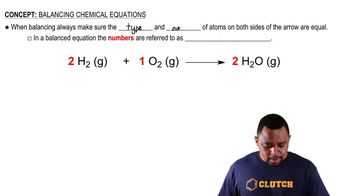
Balancing chemical equations involves ensuring that the number of atoms for each element is the same on both sides of the equation. This reflects the law of conservation of mass, which states that matter cannot be created or destroyed in a chemical reaction. In this case, potassium (K) and bromine (Br) react to form potassium bromide (KBr), and the equation must be balanced to accurately represent the reaction.
Recommended video:
Guided course
01:32
Balancing Chemical Equations (Simplified) Concept 1

Oxidation and Reduction

Oxidation and reduction are processes that involve the transfer of electrons between substances. Oxidation refers to the loss of electrons, while reduction refers to the gain of electrons. In the reaction between potassium and bromine, potassium is oxidized (loses electrons) and bromine is reduced (gains electrons), allowing for the identification of the oxidizing agent (bromine) and the reducing agent (potassium).
Recommended video:
Guided course
0:55
Reduction of Monosaccharides Example 1

Identifying Oxidizing and Reducing Agents

The oxidizing agent is the substance that causes oxidation by accepting electrons, while the reducing agent is the substance that causes reduction by donating electrons. In the given reaction, potassium acts as the reducing agent because it donates electrons, and bromine acts as the oxidizing agent because it accepts those electrons. Understanding these roles is crucial for analyzing redox reactions.
Recommended video:
Guided course
1:01
Ketoses as Reducing Sugars Example 2