Pearson+ LogoPearson+ Logo
Ch.5 Classification & Balancing of Chemical Reactions
McMurry - Fundamentals of GOB 8th Edition
McMurry8th EditionFundamentals of GOBISBN: 9780134015187Not the one you use?Change textbook
Chapter 5, Problem 75

Many pharmaceuticals are marketed with the designation "HCl" appended to the name of the drug. What does the "HCl" mean? What type of reaction would be involved in converting a drug to the HCl form? What are the advantages of this form of the drug?

Verified step by step guidance
1
The 'HCl' designation indicates that the drug is in the form of a hydrochloride salt. This means the drug has reacted with hydrochloric acid (HCl) to form a salt, which is often done to improve the drug's properties.
The type of reaction involved in converting a drug to its HCl form is an acid-base reaction. Specifically, the drug (often a weak base) reacts with hydrochloric acid (a strong acid) to form a salt. For example, if the drug contains an amine group (-NH2), it can react with HCl to form an ammonium salt (-NH3⁺Cl⁻).
The reaction can be represented as: Drug(base)+HClDrug(HCl). This process increases the solubility of the drug in water, making it easier to dissolve and absorb in the body.
One advantage of converting a drug to its HCl form is improved solubility in aqueous solutions, such as bodily fluids. This enhances the drug's bioavailability, meaning it can be absorbed more efficiently into the bloodstream.
Another advantage is increased stability. The HCl form of a drug is often more chemically stable, which can extend its shelf life and make it easier to store and transport.

Verified video answer for a similar problem:

This video solution was recommended by our tutors as helpful for the problem above.
Video duration:
2m
Was this helpful?

Key Concepts

Here are the essential concepts you must grasp in order to answer the question correctly.

Hydrochloride Salt Formation

The 'HCl' designation indicates that the drug is in the form of a hydrochloride salt. This occurs when a basic drug molecule reacts with hydrochloric acid, resulting in a more stable and soluble compound. Hydrochloride salts are commonly used to enhance the drug's bioavailability and facilitate its absorption in the body.
Recommended video:

Acid-Base Reaction

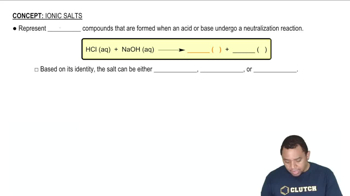
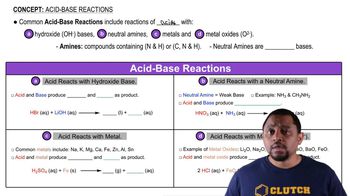
The conversion of a drug to its HCl form involves an acid-base reaction, where the basic drug (often an amine) reacts with hydrochloric acid. This reaction neutralizes the base, forming a salt and water. Understanding this reaction is crucial for grasping how the drug's chemical properties change, impacting its pharmacokinetics.
Recommended video:
Guided course
03:08
Acid-Base Reactions Concept 1

Advantages of Hydrochloride Form

The hydrochloride form of a drug offers several advantages, including improved solubility and stability, which can lead to better absorption in the gastrointestinal tract. This form can also enhance the drug's shelf life and reduce the likelihood of degradation, making it more effective for therapeutic use.
Recommended video:
Guided course
02:35
Periodic Table: Elemental Forms (Simplified) Concept 1