Pearson+ LogoPearson+ Logo
Ch.6 Chemical Reactions: Mole and Mass Relationships
McMurry - Fundamentals of GOB 8th Edition
McMurry8th EditionFundamentals of GOBISBN: 9780134015187Not the one you use?Change textbook
Chapter 6, Problem 73b

Pyrite, also known as fool's gold, is used commercially to produce SO2 used in the production of paper products.
b. How many moles of SO2 can be produced from 1.0 kg of pyrite?

Verified step by step guidance
1
Step 1: Write the balanced chemical equation for the reaction. Pyrite (FeS2) reacts with oxygen (O2) to produce sulfur dioxide (SO2) and iron(III) oxide (Fe2O3). The balanced equation is: 4FeS2 + 11O2 → 8SO2 + 2Fe2O3.
Step 2: Convert the mass of pyrite (1.0 kg) into grams, since molar mass is typically expressed in grams per mole. Use the conversion factor: 1 kg = 1000 g.
Step 3: Calculate the molar mass of pyrite (FeS2). Add the atomic masses of iron (Fe) and sulfur (S) from the periodic table: Molar mass of FeS2 = (1 × atomic mass of Fe) + (2 × atomic mass of S).
Step 4: Determine the number of moles of pyrite by dividing the mass of pyrite (in grams) by its molar mass. Use the formula: \( \text{moles of FeS}_2 = \frac{\text{mass of FeS}_2}{\text{molar mass of FeS}_2} \).
Step 5: Use the stoichiometric ratio from the balanced equation to calculate the moles of SO2 produced. From the equation, 4 moles of FeS2 produce 8 moles of SO2. Use the ratio \( \text{moles of SO}_2 = \text{moles of FeS}_2 \times \frac{8}{4} \).

Verified video answer for a similar problem:

This video solution was recommended by our tutors as helpful for the problem above.
Video duration:
4m
Was this helpful?

Key Concepts

Here are the essential concepts you must grasp in order to answer the question correctly.

Stoichiometry

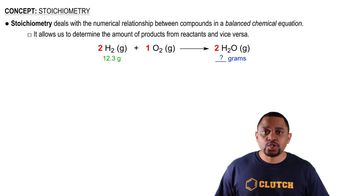
Stoichiometry is the branch of chemistry that deals with the quantitative relationships between the reactants and products in a chemical reaction. It allows us to calculate how much of a substance is needed or produced based on the balanced chemical equation. Understanding stoichiometry is essential for determining the moles of SO2 produced from a given mass of pyrite.
Recommended video:
Guided course
01:16
Stoichiometry

Molar Mass

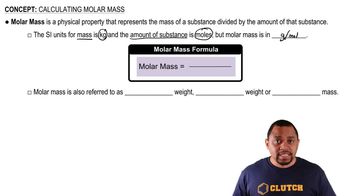
Molar mass is the mass of one mole of a substance, typically expressed in grams per mole (g/mol). It is crucial for converting between the mass of a substance and the number of moles. To solve the question, one must first calculate the molar mass of pyrite (FeS2) to determine how many moles correspond to 1.0 kg.
Recommended video:
Guided course
01:10
Calculating Molar Mass

Chemical Reaction of Pyrite

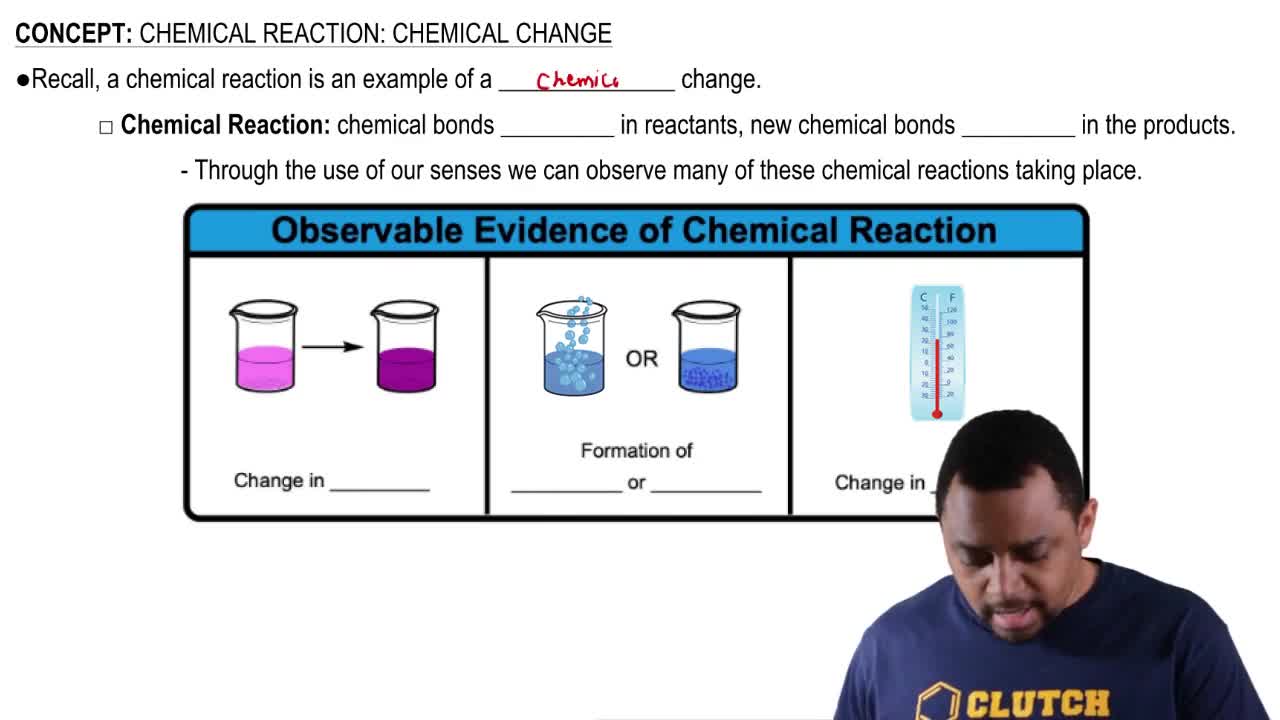
The chemical reaction of pyrite (FeS2) typically involves its oxidation to produce sulfur dioxide (SO2). The balanced equation for this reaction is essential for understanding how many moles of SO2 can be generated from a specific amount of pyrite. Knowing the stoichiometric coefficients in the reaction allows for accurate calculations of product formation.
Recommended video:
Guided course
00:58
Chemical Reaction: Chemical Change Concept 1