Pearson+ LogoPearson+ Logo
Ch.7 Chemical Reactions: Energy, Rate and Equilibrium
McMurry - Fundamentals of GOB 8th Edition
McMurry8th EditionFundamentals of GOBISBN: 9780134015187Not the one you use?Change textbook
Chapter 7, Problem 72b

For the evaporation of water, H2O(l) → H2O(g), at 100°C, ∆H = +9.72 kcal/mol (+40.7 kJ/mol).
b. How many kilojoules are released when 10.0 g of H2O(g) is condensed?

Verified step by step guidance
1
Step 1: Understand the problem. The condensation of water is the reverse of evaporation. Since evaporation absorbs energy (endothermic, ∆H = +40.7 kJ/mol), condensation releases the same amount of energy (exothermic, ∆H = -40.7 kJ/mol).
Step 2: Convert the mass of water (10.0 g) to moles. Use the molar mass of water (H₂O), which is approximately 18.02 g/mol. The formula to calculate moles is: moles = mass / molar mass.
Step 3: Calculate the energy released during condensation. Multiply the number of moles of water by the enthalpy change for condensation (∆H = -40.7 kJ/mol). The formula is: energy released = moles × ∆H.
Step 4: Ensure the correct sign for the energy change. Since condensation is exothermic, the energy released will be negative, indicating that energy is leaving the system.
Step 5: Double-check the units and ensure the final answer is in kilojoules (kJ). If necessary, confirm that all intermediate calculations are consistent with the given data.

Verified video answer for a similar problem:

This video solution was recommended by our tutors as helpful for the problem above.
Video duration:
3m
Was this helpful?

Key Concepts

Here are the essential concepts you must grasp in order to answer the question correctly.

Enthalpy of Vaporization

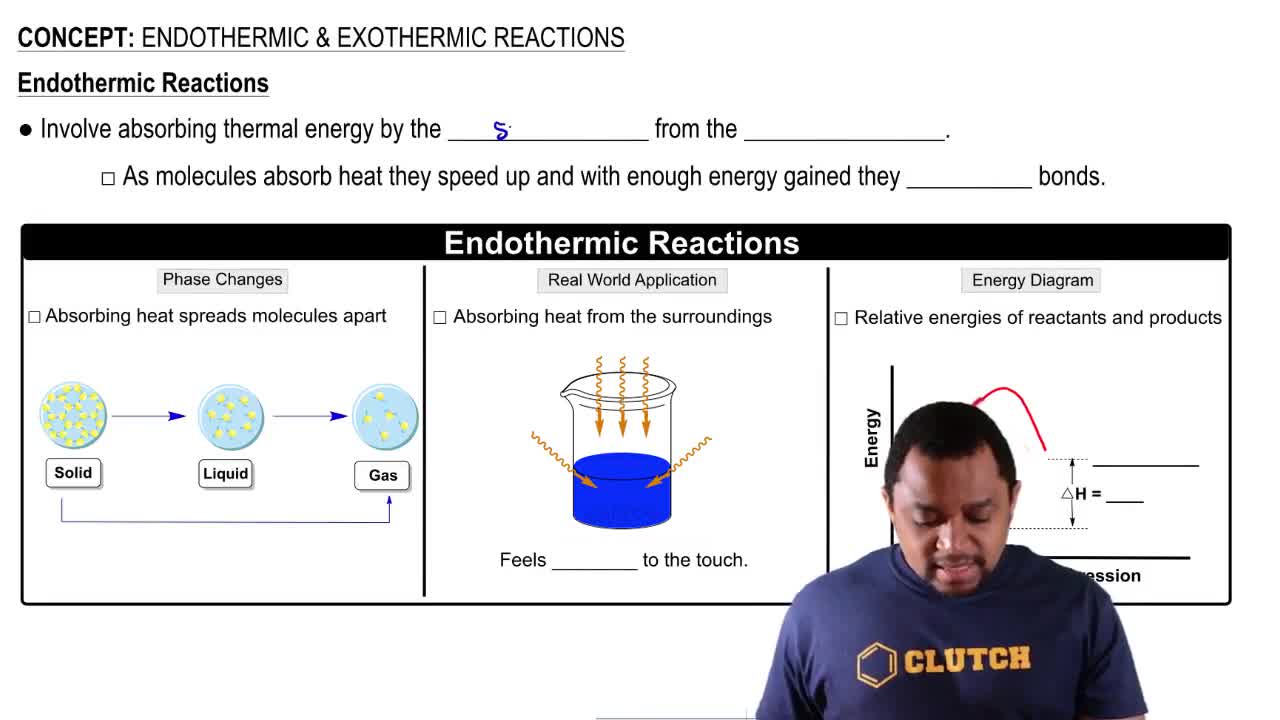
The enthalpy of vaporization is the amount of energy required to convert a unit mass of a substance from liquid to gas at a constant temperature and pressure. For water, this value is positive when vaporizing, indicating energy absorption. Conversely, during condensation, the same amount of energy is released, which is crucial for calculating energy changes in phase transitions.
Recommended video:
Guided course
02:30
Endothermic & Exothermic Reactions

Molar Mass of Water

The molar mass of water (H2O) is approximately 18.02 g/mol. This value is essential for converting between grams of water and moles, allowing for the calculation of energy changes based on the number of moles involved in the phase change. Understanding molar mass is fundamental in stoichiometry and thermodynamic calculations.
Recommended video:
Guided course
01:10
Calculating Molar Mass

Energy Conversion

Energy conversion refers to the process of changing energy from one form to another. In this context, it involves converting the energy associated with the phase change of water from gas to liquid, quantified in kilojoules. Recognizing how to convert between different energy units (e.g., kcal to kJ) is vital for accurate calculations in thermodynamics.
Recommended video:
Guided course
03:45
Conversion Factors (Simplified) Example 2