Pearson+ LogoPearson+ Logo
Ch.7 Chemical Reactions: Energy, Rate and Equilibrium
McMurry - Fundamentals of GOB 8th Edition
McMurry8th EditionFundamentals of GOBISBN: 9780134015187Not the one you use?Change textbook
Chapter 7, Problem 36

Under what conditions might a reaction be endothermic but exergonic? Explain.

Verified step by step guidance
1
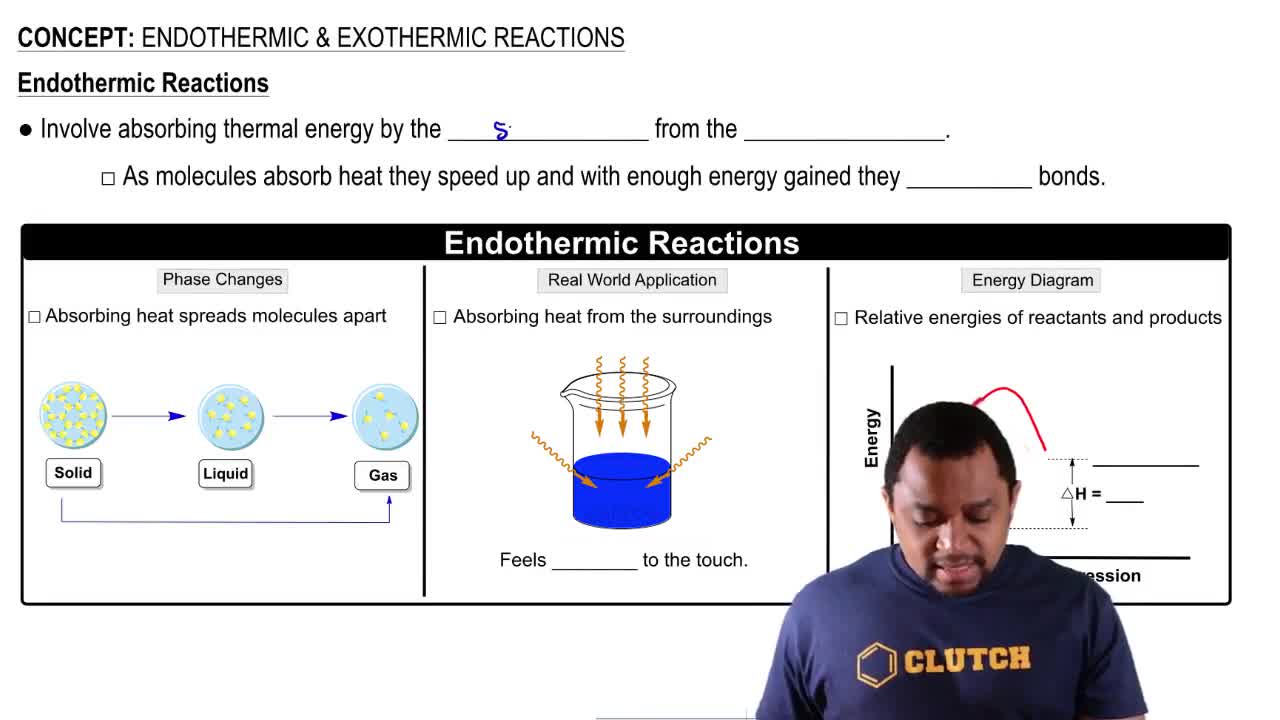
Understand the key terms: An endothermic reaction absorbs heat from the surroundings (ΔH > 0), while an exergonic reaction is spontaneous, meaning it has a negative Gibbs free energy change (ΔG < 0).
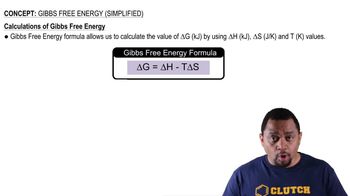
Recall the Gibbs free energy equation: ΔG = ΔH - TΔS, where ΔG is the Gibbs free energy change, ΔH is the enthalpy change, T is the temperature in Kelvin, and ΔS is the entropy change.
Analyze the relationship between the terms: For a reaction to be endothermic (ΔH > 0) but still exergonic (ΔG < 0), the term TΔS must be large enough to outweigh the positive ΔH. This means the entropy change (ΔS) must be positive and significant, and the temperature (T) must be high.
Consider the physical meaning: A positive ΔS indicates an increase in disorder or randomness in the system, such as when a solid dissolves into a liquid or a liquid evaporates into a gas. At high temperatures, the contribution of TΔS becomes more dominant in the Gibbs free energy equation.
Conclude the conditions: A reaction can be endothermic but exergonic if it has a large positive entropy change (ΔS > 0) and occurs at a sufficiently high temperature (T), ensuring that the term TΔS outweighs the positive ΔH.

Verified video answer for a similar problem:

This video solution was recommended by our tutors as helpful for the problem above.
Video duration:
5m
Was this helpful?

Key Concepts

Here are the essential concepts you must grasp in order to answer the question correctly.

Endothermic Reactions

Endothermic reactions are chemical processes that absorb heat from their surroundings, resulting in a decrease in temperature of the environment. This occurs when the energy required to break bonds in the reactants exceeds the energy released when new bonds form in the products. A common example is the dissolution of ammonium nitrate in water, which absorbs heat and feels cold.
Recommended video:
Guided course
02:30
Endothermic & Exothermic Reactions

Exergonic Reactions

Exergonic reactions are those that release free energy, making them spontaneous under certain conditions. The Gibbs free energy change (ΔG) for these reactions is negative, indicating that the products have lower energy than the reactants. An example is the combustion of glucose, which releases energy that can be harnessed for biological processes.
Recommended video:
Guided course
1:30
Alcohol Reactions: Dehydration Reactions Concept 1

Gibbs Free Energy

Gibbs free energy (G) is a thermodynamic potential that helps predict the direction of chemical reactions. It combines enthalpy (heat content) and entropy (disorder) to determine whether a reaction is spontaneous. A reaction can be endothermic (positive ΔH) yet exergonic (negative ΔG) if the increase in entropy (ΔS) is significant enough to offset the heat absorbed, allowing the reaction to proceed spontaneously.
Recommended video:
Guided course
01:04
Gibbs Free Energy (Simplified) Concept 3