Pearson+ LogoPearson+ Logo
Ch.7 Chemical Reactions: Energy, Rate and Equilibrium
McMurry - Fundamentals of GOB 8th Edition
McMurry8th EditionFundamentals of GOBISBN: 9780134015187Not the one you use?Change textbook
Chapter 7, Problem 38b

For the reaction 2 Hg(l) + O2(g) → 2 HgO(s), ∆H = –43 kcal/mol (–180 kJ/mol).
b. Under what conditions would you expect this process to be spontaneous?

Verified step by step guidance
1
Determine the thermodynamic criteria for spontaneity: A process is spontaneous when the Gibbs free energy change (ΔG) is negative. The relationship is given by the equation: ΔG=ΔH-TΔS, where ΔH is the enthalpy change, T is the temperature in Kelvin, and ΔS is the entropy change.
Analyze the given data: The reaction has a negative enthalpy change (ΔH = -43 kcal/mol or -180 kJ/mol), indicating that it is exothermic. This means the system releases heat to the surroundings.
Consider the entropy change (ΔS): The reaction involves the combination of liquid mercury (Hg) and oxygen gas (O2) to form solid mercury(II) oxide (HgO). Since gases have higher entropy than solids, the entropy of the system likely decreases (ΔS < 0).
Evaluate the temperature dependence: Since ΔH is negative and ΔS is negative, the term -TΔS becomes positive as temperature increases. For the reaction to remain spontaneous (ΔG < 0), the magnitude of ΔH must outweigh the positive -TΔS term, which is more likely at lower temperatures.
Conclude the conditions for spontaneity: This reaction is expected to be spontaneous at lower temperatures where the exothermic enthalpy change (ΔH) dominates over the unfavorable entropy change (ΔS).

Verified video answer for a similar problem:

This video solution was recommended by our tutors as helpful for the problem above.
Video duration:
4m
Was this helpful?

Key Concepts

Here are the essential concepts you must grasp in order to answer the question correctly.

Gibbs Free Energy

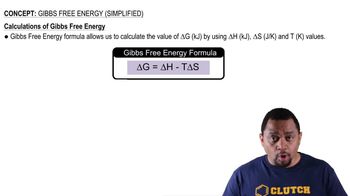
Gibbs Free Energy (G) is a thermodynamic potential that helps predict the spontaneity of a process at constant temperature and pressure. A reaction is spontaneous if the change in Gibbs Free Energy (∆G) is negative. The relationship between enthalpy (∆H), entropy (∆S), and temperature (T) is given by the equation ∆G = ∆H - T∆S, where a negative ∆G indicates a spontaneous reaction.
Recommended video:
Guided course
01:04
Gibbs Free Energy (Simplified) Concept 3

Enthalpy and Exothermic Reactions

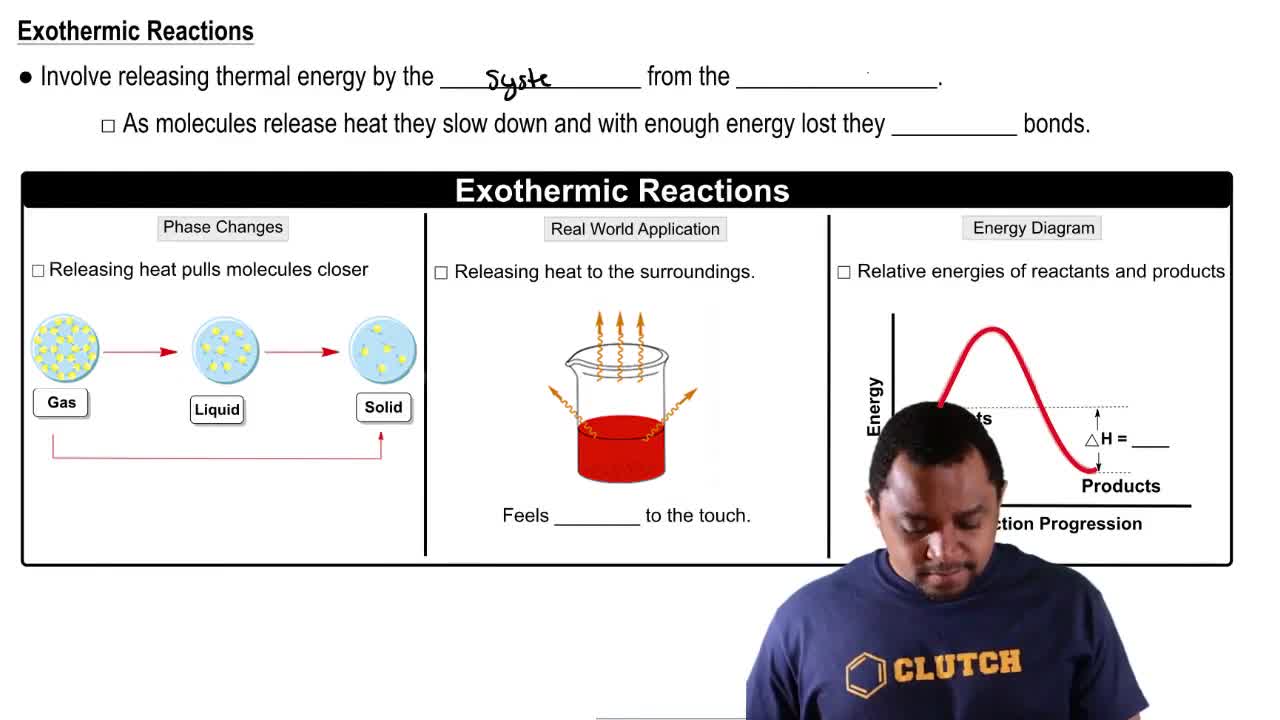
Enthalpy (H) is a measure of the total energy of a thermodynamic system, and reactions that release energy, such as the given reaction with ∆H = -43 kcal/mol, are termed exothermic. Exothermic reactions tend to favor spontaneity because they result in a decrease in enthalpy, which contributes to a negative ∆G under appropriate conditions, particularly at lower temperatures.
Recommended video:
Guided course
02:38
Endothermic & Exothermic Reactions

Entropy and Disorder

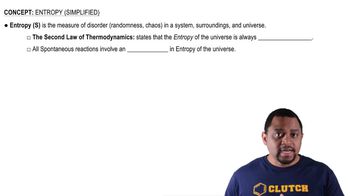
Entropy (S) is a measure of the disorder or randomness in a system. In general, processes that increase the entropy of the universe are favored. For the reaction 2 Hg(l) + O2 → 2HgO(s), the formation of a solid from liquids and gases typically results in a decrease in entropy, which can affect spontaneity. Understanding the balance between enthalpy and entropy is crucial for determining the conditions under which the reaction is spontaneous.
Recommended video:
Guided course
00:54
Entropy (Simplified) Concept 1