
Textbook Question
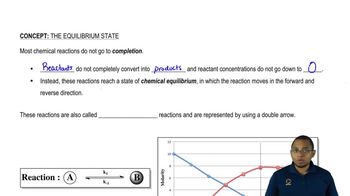
What is meant by the term 'chemical equilibrium'? Must amounts of reactants and products be equal at equilibrium?
1936
views

 Verified step by step guidance
 03:42
03:42
 1:17
1:17 09:34
09:34What is meant by the term 'chemical equilibrium'? Must amounts of reactants and products be equal at equilibrium?
For the reaction C(s, diamond) → C(s, graphite), ∆G = -0.693 kcal/mol (-2.90 kJ/mol) at 25 °C.
a. According to this information, do diamonds spontaneously turn into graphite?
Write the equilibrium constant expressions for the following reactions:
a. 2 CO(g) + O2(g) ⇌ 2 CO2(g)
The reaction between hydrogen gas and carbon to produce the gas known as ethylene is:
2 H2(g) + 2 C(s) → H2C=CH2(g), ∆G = +16.3 kcal/mol (+68 kJ/mol) 25 °C.
a. Is this reaction spontaneous at 25 °C?
Write the equilibrium constant expressions for the following reactions.
d. C(s) + H2O(g) ⇌ CO(g) + H2(g)
Use your answer from Problem 7.53 to calculate the following:
a. [N2O4] at equilibrium when [NO2] = 0.0250 mol/L