If a catalyst changes the activation energy of a forward reaction from 28.0 kcal/mol to 23.0 kcal/mol, what effect does it have on the reverse reaction?
Ch.7 Chemical Reactions: Energy, Rate and Equilibrium
Chapter 7, Problem 49
What is meant by the term 'chemical equilibrium'? Must amounts of reactants and products be equal at equilibrium?
Verified step by step guidance1
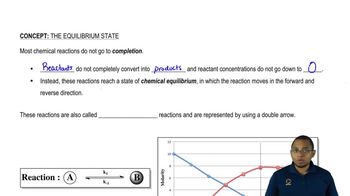
Chemical equilibrium refers to the state in a chemical reaction where the rate of the forward reaction (reactants converting to products) equals the rate of the reverse reaction (products converting back to reactants). At this point, the concentrations of reactants and products remain constant over time, though they are not necessarily equal.
Understand that equilibrium is a dynamic process, meaning that both the forward and reverse reactions are still occurring, but they happen at the same rate, so there is no net change in the concentrations of reactants and products.
No, the amounts of reactants and products do not have to be equal at equilibrium. The relative concentrations depend on the equilibrium constant (K), which is determined by the specific reaction and its conditions (e.g., temperature).
The equilibrium constant (K) is expressed as the ratio of the concentrations of products to reactants, each raised to the power of their respective coefficients in the balanced chemical equation. For example, for a reaction \( aA + bB \leftrightarrow cC + dD \), the equilibrium constant is \( K = \frac{[C]^c[D]^d}{[A]^a[B]^b} \).
In summary, chemical equilibrium is about the balance of reaction rates, not the equality of reactant and product amounts. The specific ratio of concentrations at equilibrium is determined by the equilibrium constant for the reaction.

Verified video answer for a similar problem:
This video solution was recommended by our tutors as helpful for the problem above.
Video duration:
1mWas this helpful?
Key Concepts
Here are the essential concepts you must grasp in order to answer the question correctly.
Chemical Equilibrium
Chemical equilibrium refers to a state in a reversible chemical reaction where the rates of the forward and reverse reactions are equal, resulting in constant concentrations of reactants and products over time. This dynamic balance means that while the reaction continues to occur, there is no net change in the amounts of substances involved.
Recommended video:
Guided course
Chemical Equilibrium Concept 1
Dynamic Nature of Equilibrium
Equilibrium is not a static condition; rather, it is dynamic, meaning that the reactants and products are constantly being converted into one another. This ongoing process allows for the concentrations of reactants and products to remain constant, even though individual molecules are still reacting.
Recommended video:
Guided course
Nature of Energy
Concentration Ratios
At equilibrium, the concentrations of reactants and products are related by the equilibrium constant (K), which reflects the ratio of product concentrations to reactant concentrations raised to the power of their coefficients in the balanced equation. This means that the amounts of reactants and products do not have to be equal; rather, they depend on the specific reaction and its conditions.
Recommended video:
Guided course
Percent Concentrations Concept 1
Related Practice
Textbook Question
1447
views
Textbook Question
For the reaction C(s, diamond) → C(s, graphite), ∆G = -0.693 kcal/mol (-2.90 kJ/mol) at 25 °C.
a. According to this information, do diamonds spontaneously turn into graphite?
1526
views
Textbook Question
The reaction between hydrogen gas and carbon to produce the gas known as ethylene is:
2 H2(g) + 2 C(s) → H2C=CH2(g), ∆G = +16.3 kcal/mol (+68 kJ/mol) 25 °C.
a. Is this reaction spontaneous at 25 °C?
972
views
Textbook Question
Why do catalysts not alter the amounts of reactants and products present at equilibrium?
1386
views
Textbook Question
Write the equilibrium constant expressions for the following reactions:
a. 2 CO(g) + O2(g) ⇌ 2 CO2(g)
1419
views
Textbook Question
Write the equilibrium constant expressions for the following reactions.
d. C(s) + H2O(g) ⇌ CO(g) + H2(g)
1400
views