Pearson+ LogoPearson+ Logo
Ch.9 Solutions
McMurry - Fundamentals of GOB 8th Edition
McMurry8th EditionFundamentals of GOBISBN: 9780134015187Not the one you use?Change textbook
Chapter 9, Problem 50

How many moles of each substance are needed to prepare the following solutions?
a. 50.0 mL of 8.0% (m/v) KCl (MW = 74.55 g/mol)
b. 200.0 mL of 7.5% (m/v) acetic acid (MW = 60.05 g/mol)

Verified step by step guidance
1
Step 1: Understand the problem. The (m/v) percentage indicates the mass of solute (in grams) per 100 mL of solution. To find the moles of solute, we need to calculate the mass of solute first using the given volume and percentage, then convert the mass to moles using the molar mass (MW).
Step 2: For part (a), calculate the mass of KCl required. Use the formula: \( \text{Mass of solute (g)} = \text{(m/v percentage)} \times \frac{\text{Volume of solution (mL)}}{100} \). Substitute \( 8.0\% \) and \( 50.0 \ \text{mL} \) into the formula.
Step 3: Convert the mass of KCl obtained in Step 2 to moles using the molar mass of KCl. Use the formula: \( \text{Moles of KCl} = \frac{\text{Mass of KCl (g)}}{\text{Molar mass of KCl (g/mol)}} \). Substitute the calculated mass and \( 74.55 \ \text{g/mol} \).
Step 4: For part (b), calculate the mass of acetic acid required. Use the same formula as in Step 2: \( \text{Mass of solute (g)} = \text{(m/v percentage)} \times \frac{\text{Volume of solution (mL)}}{100} \). Substitute \( 7.5\% \) and \( 200.0 \ \text{mL} \) into the formula.
Step 5: Convert the mass of acetic acid obtained in Step 4 to moles using the molar mass of acetic acid. Use the formula: \( \text{Moles of acetic acid} = \frac{\text{Mass of acetic acid (g)}}{\text{Molar mass of acetic acid (g/mol)}} \). Substitute the calculated mass and \( 60.05 \ \text{g/mol} \).

Verified video answer for a similar problem:

This video solution was recommended by our tutors as helpful for the problem above.
Video duration:
4m
Was this helpful?

Key Concepts

Here are the essential concepts you must grasp in order to answer the question correctly.

Molarity and Moles

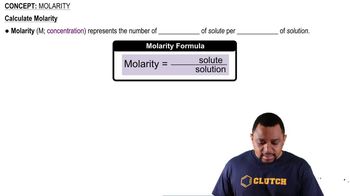
Molarity is a measure of concentration defined as the number of moles of solute per liter of solution. To find the number of moles, one can use the formula: moles = mass (g) / molar mass (g/mol). Understanding how to convert between mass and moles is essential for preparing solutions accurately.
Recommended video:

Percent by Mass/Volume (m/v)

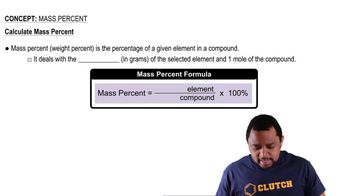
Percent by mass/volume (m/v) is a way to express the concentration of a solution, indicating the grams of solute per 100 mL of solution. For example, an 8.0% (m/v) KCl solution contains 8.0 grams of KCl in 100 mL of solution. This concept is crucial for calculating the required mass of solute for a given volume of solution.
Recommended video:
Guided course
00:38
Mass Percent Concept

Dilution and Solution Preparation

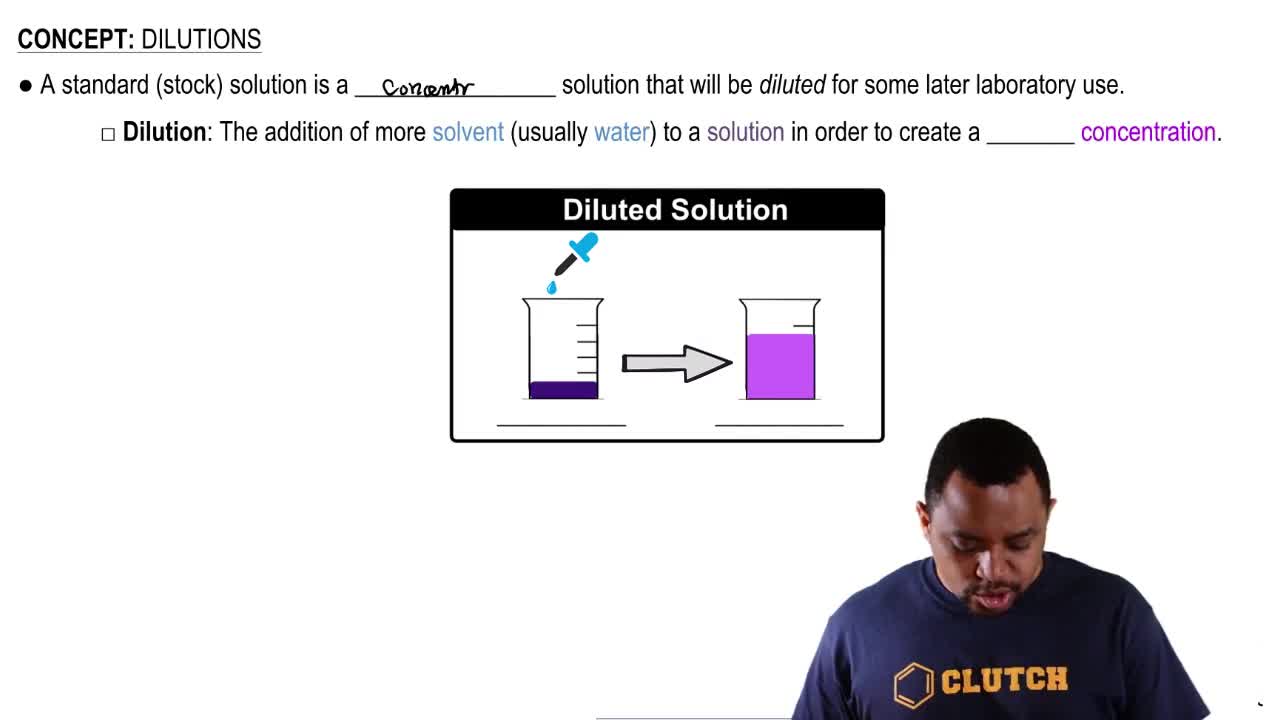
Dilution involves reducing the concentration of a solute in a solution, typically by adding more solvent. When preparing solutions, it is important to calculate the correct amount of solute needed based on the desired concentration and volume. This ensures that the final solution meets the specified concentration requirements.
Recommended video: